



TL;DR: Travel and tourism marketing works when it meets travelers in the moment, while they’re dreaming of a getaway, comparing destinations, or a click away from booking. Destinations, attractions, and tour operators that combine first-party data, full-funnel strategy, and dynamic creative tied to real availability consistently outperform those relying on broad reach or one-off campaigns. This playbook covers how to build that program from the ground up.
Wanderlust is everywhere. Nearly everyone dreams of somewhere to go, and short-form video, influencer content, and travel media have made destination discovery constant and ambient. The harder part is converting that daydream into a booked trip, with the right message, on the right channel, at exactly the moment a traveler is ready to commit.
A generic destination awareness campaign running in October performs very differently than a geo-targeted, dynamic creative push showing “seats remaining this weekend” to travelers in a drive-market during a shoulder-season lull. Travelers make decisions based on timing, trust, and the promise of an experience worth sharing, and the destinations, attractions, and operators that understand those drivers, and build media around them, are the ones filling rooms, activations, and itineraries.
At KORTX, we help travel and tourism brands and the agencies that serve them turn audience intelligence into measurable outcomes: bookings, stays, ticketed visits, loyalty enrollments, and repeat travelers season over season. We’ve built campaigns for destination marketing organizations, attractions, regional tourism boards, and tour operators, and the patterns that drive performance are consistent.
What Makes Travel & Tourism Advertising Different
Travel and tourism marketing operates under a distinct set of rules. The total addressable market is enormous (nearly everyone travels in some form), but that scale is misleading. The brands that win treat travel advertising as an exercise in relevance, connecting the right traveler to the right destination or experience at the right point in a long, emotional decision journey.
A few realities define how effective travel and tourism advertising must be planned:
- The journey is long and nonlinear. Travelers dream for months before they plan, and plan for weeks before they book. A campaign built for a single moment misses most of the journey: inspiration, planning, booking, and the trip itself all require distinct messaging.
- Seasonality and origin markets shape everything. Demand shifts by time of year, by drive-market versus fly-market, and by domestic versus international traveler. Media weight and message should shift with it, rather than running the same campaign year-round.
- Content and social proof drive the decision. Short-form video, influencer content, and user-generated reviews carry more weight in travel than in almost any other category. Travelers trust other travelers before they trust an ad.
- Availability and timing are creative levers. “Only 2 rooms left this weekend” or “Direct flights from your city” outperform generic “Visit us” messaging because they turn logistics into urgency.
- The trip is the marketing. A guest’s on-property experience, their photos, their reviews, becomes the next campaign’s creative. Programs that treat post-trip advocacy as an afterthought leave the highest-value, lowest-cost growth lever on the table.

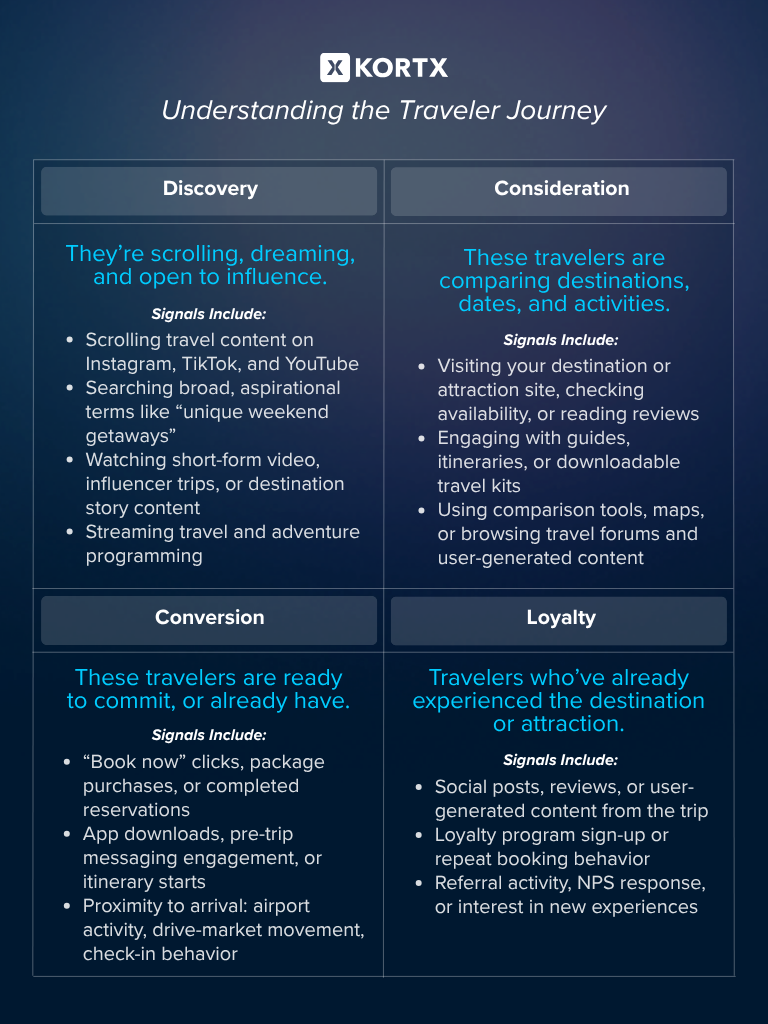
Understanding the Traveler Journey
Travelers don’t move through a straight line from dreaming to booking. A scroll through Instagram can turn into a booked weekend within days; a months-long research process can end with no action at all. Effective campaigns meet travelers wherever they are in that journey and move them toward a trip.
Stage 1: Inspiration & Discovery (Awareness and Daydreaming)
These are travelers who aren’t actively planning a trip but are absorbing content that shapes where they’ll go next. They’re scrolling, dreaming, and open to influence long before a destination decision firms up.
Typical signals include:
- Scrolling travel content on Instagram, TikTok, and YouTube
- Searching broad, aspirational terms like “unique weekend getaways” or “best national parks”
- Watching short-form video, influencer trips, or destination story content
- Streaming travel and adventure programming
Advertising strategy: Build emotional recognition before the planning window opens. CTV and streaming video showcasing destination lifestyle and signature experiences; short-form social and influencer content telling authentic stories of the place; native placements in travel, lifestyle, and adventure content environments with high emotional pull.
Goal: Make the destination, attraction, or experience top-of-mind before the traveler starts actively planning.
Stage 2: Consideration & Planning (Comparing and Researching)
These travelers are comparing: destinations, dates, accommodations, activities. They’ve moved from dreaming to researching, and they need a reason to choose your destination over the dozens of others competing for the same trip.
Typical signals include:
- Visiting your destination or attraction site, checking availability, or reading reviews
- Engaging with guides, itineraries, or downloadable travel kits
- Using comparison tools, maps, or browsing travel forums and user-generated content
Advertising strategy: Move from inspiration to conviction with specificity. Retargeting based on site visits, itinerary pages, or availability searches; interactive rich media like trip builders, best-time-to-visit tools, or experience comparisons; email and SMS capture through downloadable guides or itineraries; early-book incentives and package bundles that reduce decision friction.
Goal: Turn passive research into an intent to book with you specifically.
Stage 3: Booking & Trip Execution (Commit and Go)
These travelers are ready to commit, or already have. They include last-minute bookers, confirmed guests preparing for arrival, and travelers actively on their trip. Friction and timing matter most here.
Typical signals include:
- “Book now” clicks, package purchases, or completed reservations
- App downloads, pre-trip messaging engagement, or itinerary starts
- Proximity to arrival: airport activity, drive-market movement, check-in behavior
Advertising strategy: Remove friction and create urgency. Dynamic creative reflecting real availability: “seats remaining,” “book this weekend”; geo-targeting for drive-markets, airport arrivals, and adjacent travel hubs; mobile-first, click-to-book experiences; pre-arrival nurture content and on-site upsell for excursions and add-ons.
Goal: Convert intent into a confirmed, seamless booking and trip experience.
Stage 4: Post-Trip & Advocacy (Loyalty and Referral)
These are travelers who’ve already experienced the destination or attraction. They represent the highest-value opportunity in travel marketing: repeat visitation, referrals, and content that fuels the next campaign.
Typical signals include:
- Social posts, reviews, or user-generated content from the trip
- Loyalty program sign-up or repeat booking behavior
- Referral activity, NPS response, or interest in new experiences
Advertising strategy: Lead with recognition and reward. Email and SMS campaigns inviting guests to share photos, refer a friend, or unlock loyalty upgrades; social campaigns encouraging UGC through hashtags or photo contests; retargeting for future visits tied to new seasons, attractions, or experiences.
Goal: Turn a single trip into a lasting relationship, and turn guests into ambassadors.
How to Build a Travel & Tourism Audience Strategy
The total addressable market in travel and tourism can look limitless (nearly everyone travels, in some form). But treating travel as mass marketing is where most programs fail. The travelers most likely to book this season are a much smaller, more predictable group than “people who travel.”
At KORTX, we use an audience-first framework to help travel and tourism brands and agencies define the real addressable opportunity and build toward it.
- First-party data activation. Past guests, loyalty members, and site inquiries are the foundation. We use these audiences to retarget high-propensity travelers, build lookalike models, and suppress recent bookers from acquisition spend, so no dollar is wasted reaching someone already in the funnel.
- Behavioral and intent segmentation. We segment beyond demographics, distinguishing the spontaneous short-break traveler from the planned long-haul vacationer, the business traveler from the family on leisure, the off-season deal-seeker from the peak-season luxury booker. Each segment gets a different message, a different channel mix, and a different call to action.
- Geographic and origin-market precision. Travel audiences are layered by drive-market proximity, origin-market travel patterns, and domestic versus international demand. Campaign budgets and messaging should reflect those tiers, not a single national message.
- Intent and contextual signals. Search behavior around destination and activity keywords, travel review-site visits, and short-form video engagement all indicate high-intent travelers worth prioritizing with conversion-focused creative.
- Dynamic exclusion. We actively manage audience suppression, excluding unrealistic or out-of-geography leads, low-intent browsers, and travelers who’ve already booked, so budget concentrates on the segments most likely to convert.
- KORTX Intelligence. Built on more than a decade of campaign performance data across 10,000+ campaigns, 1 billion+ user records, and 15,000+ audience attributes, including travel-specific behavioral, intent, and origin-market data, helps us move from audience hypothesis to audience confidence before a campaign launches.
Travel & Tourism Advertising Funnel Strategy
Travel campaigns are long-lead and emotional, which means they demand a full-funnel media strategy that spans discovery through post-trip advocacy. The destinations and operators that perform are the ones that show up at every stage: building desire before the planning window opens, converting during peak booking windows, and turning guests into repeat travelers after the trip ends.
Top-of-Funnel: Inspire and Build Desire
Tactics include CTV and streaming video showcasing destination lifestyle, signature attractions, and unique experiences; short-form social video and influencer content telling authentic stories of the place; native placements in travel, lifestyle, and adventure content with high emotional pull.
The goal is to build awareness and emotional appeal so the destination is top-of-mind when planning begins.
Mid-Funnel: Drive Consideration and Planning
Tactics include retargeting based on site visits, itinerary pages, and availability searches; interactive rich media with trip builders, best-time-to-visit tools, and experience comparisons; email and SMS capture through downloadable guides and itineraries; early-book incentives, package bundles, and local-insider content.
The goal is to move travelers from dreaming to planning, and reduce the friction between interest and commitment.
Lower-Funnel: Convert and Execute
Tactics include dynamic ads reflecting real availability: “seats remaining,” “book this weekend”; click-to-book and mobile-first experiences built for travelers ready to commit; geo-targeting for drive-markets, airport arrivals, and adjacent travel hubs; pre-arrival nurture content and cross-sell for excursions and add-ons.
The goal is to convert interest into a confirmed booking and set up a seamless trip experience.
Post-Trip: Build Loyalty and Advocacy
Tactics include email and SMS campaigns inviting guests to share photos, refer a friend, or unlock loyalty upgrades; social campaigns built around UGC, hashtags, and photo contests; retargeting for future visits tied to new seasons, attractions, or experiences; CRM-based reactivation ahead of the next relevant season.
The goal is to turn a single trip into a lifetime relationship, and guests into ambassadors.
Travel & Tourism Creative Strategy: Story, Trust, and a Reason to Go Now
In travel and tourism, creative has to do heavy lifting. It has to evoke emotion, build authenticity, deliver clarity on logistics, and prompt action, often all in a single unit. The most effective travel creative shares a few consistent traits.
- It leads with the experience, not the itinerary. “Escape the ordinary” and “Discover hidden gems of X” outperform feature lists. Travelers are buying a feeling before they’re buying a flight.
- It uses real visuals. Drone footage, travelers in action, and immersive scenes outperform postcard stock photography. Authenticity is a trust signal in travel more than in almost any other category.
- It shows ease and relevance. “Direct flights from your city,” “Packages starting at,” and “Family-friendly, pet-friendly” reduce the perceived effort of getting there.
- It carries proof. Reviews, guest testimonials, ratings, and local endorsements do more to move a travel decision than brand messaging alone.
- It creates urgency through specificity. “Only 3 rooms left this weekend” outperforms “Book now” because it turns availability into a reason to act today.
Formats that consistently perform include short-form video (15–30 seconds) optimized for social and mobile; interactive content like virtual tours or AR/VR previews of destinations and experiences; dynamic display and video creative that changes by origin market, travel window, and availability; mobile-first formats with map integration and easy booking; influencer and UGC assets embedded directly into paid campaigns.
The Travel & Tourism Marketing Calendar
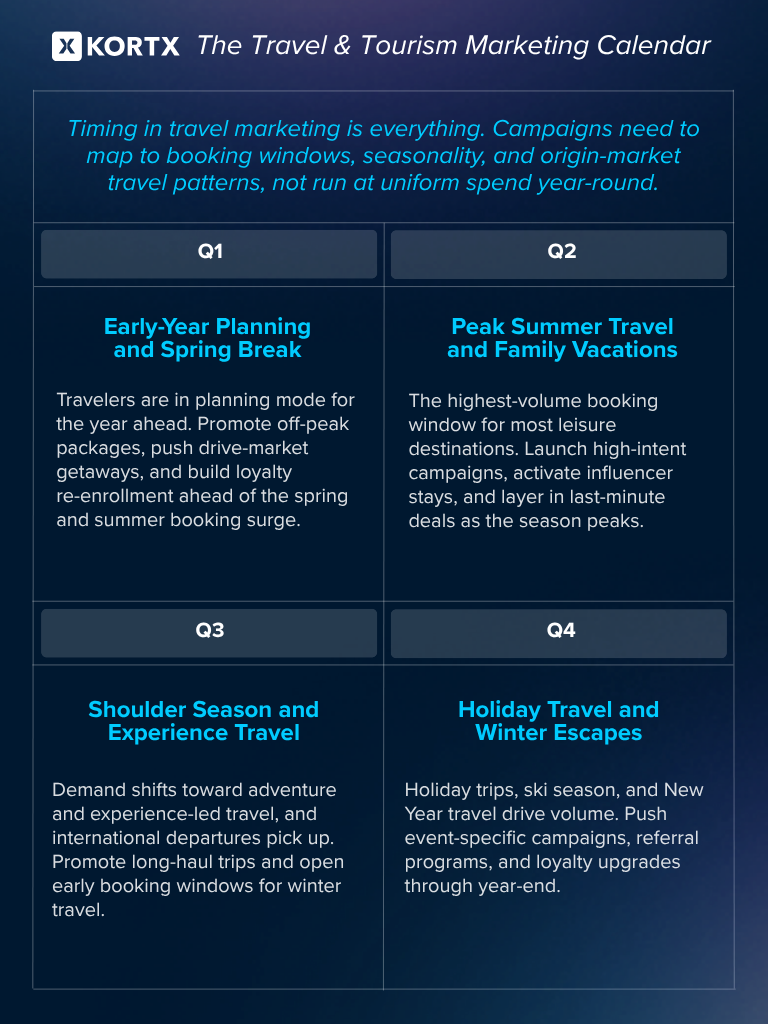
Timing in travel marketing is everything. Campaigns need to map to booking windows, seasonality, and origin-market travel patterns, not run at uniform spend year-round.
- Q1: Early-Year Planning and Spring Break. Travelers are in planning mode for the year ahead. Promote off-peak packages, push drive-market getaways, and build loyalty re-enrollment ahead of the spring and summer booking surge.
- Q2: Peak Summer Travel and Family Vacations. The highest-volume booking window for most leisure destinations. Launch high-intent campaigns, activate influencer stays, and layer in last-minute deals as the season peaks.
- Q3: Shoulder Season and Experience Travel. Demand shifts toward adventure and experience-led travel, and international departures pick up. Promote long-haul trips and open early booking windows for winter travel.
- Q4: Holiday Travel and Winter Escapes. Holiday trips, ski season, and New Year travel drive volume. Push event-specific campaigns, referral programs, and loyalty upgrades through year-end.
Also layer in micro-moments throughout: event-specific campaigns tied to festivals, concerts, or cultural moments; geo-specific ads triggered by airport arrivals or travel-hub activity; flash offers and last-minute deals for mobile audiences already close to a decision. These windows are among the most efficient conversion opportunities available, provided creative and budget are ready to activate quickly.
How to Measure Travel & Tourism Advertising Performance
Travel brands aren’t buying impressions. They’re driving bookings, stays, visits, and repeat travelers. Measurement frameworks need to reflect the full path from inspiration to booking to advocacy.
The metrics we track include:
- Booking requests, package purchases, and quote inquiries by channel and campaign
- Cost per booking, cost per stay, and cost per visitor acquisition
- Occupancy rate, average length of stay, and spend per visitor
- Repeat visit rate, referral volume, and loyalty program enrollment
- Incremental lift in visitation from specific origin markets or traveler segments
- Multi-touch attribution connecting inspiration (video), consideration (site visit), and booking (transaction)
For agencies, we build reporting infrastructure that connects campaign performance to client business outcomes, making it straightforward to demonstrate media’s contribution to bookings, visitation, and loyalty growth in client reviews.
How KORTX Helps Travel & Tourism Brands and Agencies
Travel and tourism advertising rewards brands that combine audience precision, full-funnel activation, and dynamic creative built around real traveler behavior. KORTX partners with destinations, attractions, tourism boards, and tour operators, and the agencies that serve them, to deliver:
- Audience-first targeting built from first-party guest data, behavioral signals, and KORTX Intelligence across 1B+ user records and 15,000+ audience attributes, including travel-specific intent and origin-market data
- Full-funnel Omnichannel activation across CTV, programmatic, paid social, audio, and paid search, coordinated around booking windows and seasonality
- Dynamic creative strategies that adapt to real-time availability, origin market, and travel window
- Measurement frameworks that connect media spend to bookings, stays, visitation, and loyalty growth
- Agency partnership infrastructure including white-label reporting, client-ready dashboards, and dedicated strategic support
The result is advertising that moves travelers through the funnel, from daydream to booking to repeat guest, with outcomes tied to the metrics travel organizations actually care about.
Final Takeaway: In Travel & Tourism, Experience-Driven Strategy Wins
Travel and tourism marketing is not about being seen by everyone. It’s about being seen by the traveler who’s ready to pack now, with a story that makes booking feel effortless and an experience worth sharing once they’ve gone.
The destinations, attractions, and operators that drive consistent visitation are the ones who treat audience intelligence as a competitive advantage, align media investment to the rhythms of the travel calendar, and build creative that earns trust and urgency in equal measure.
At KORTX, we’ve helped travel and tourism brands build exactly that kind of program: one that turns wanderlust into bookings, and bookings into loyalty.
Let’s talk travel and tourism strategy →
Frequently Asked Questions
What is travel and tourism advertising?
Travel and tourism advertising is the strategy and execution of paid media designed to build destination awareness, drive bookings, and grow loyalty for destination marketing organizations, attractions, regional tourism boards, and tour operators. Effective travel advertising combines audience targeting, full-funnel campaign strategy tied to the traveler’s decision journey, creative that builds trust and urgency, and measurement that connects media investment to bookings, visitation, and repeat travel.
Unlike categories with short purchase cycles, travel decisions often unfold over months, moving from inspiration to planning to booking, which means campaigns need to reach travelers at every stage and move them forward without losing momentum.
How is travel and tourism advertising different from other verticals?
Travel and tourism advertising is defined by three characteristics that set it apart. First, the decision journey is unusually long and emotional: travelers dream for months before they plan, which means a single campaign moment can’t carry the full journey. Second, seasonality and origin market are structural, not incidental. Demand shifts by time of year, drive-market versus fly-market, and domestic versus international traveler, and media weight needs to shift with it. Third, content and social proof carry outsized influence. Short-form video, influencer content, and traveler reviews shape destination decisions more than in almost any other category, which puts a premium on authentic creative over polished brand messaging.
What is the best media mix for travel and tourism advertising?
A high-performing travel media mix typically combines CTV and streaming video for destination and experience awareness, short-form social and influencer content for discovery and emotional engagement, programmatic display and dynamic creative for retargeting and availability-based conversion messaging, paid search to capture travelers actively comparing destinations, and geo-targeted mobile for drive-market and airport-proximity conversion. The right balance depends on the destination type, origin-market footprint, and booking window. Inspiration-stage campaigns lean toward CTV, social video, and native content. Conversion-stage campaigns prioritize dynamic display, retargeting, and mobile. Loyalty and advocacy campaigns rely on CRM-based audiences, email, and UGC-driven social.
How do you measure the impact of travel advertising on bookings?
Connecting media to bookings requires a combination of direct and modeled attribution. Click-to-book tracking and platform integrations with reservation systems provide direct measurement of media-driven bookings. For broader campaign impact, incremental lift modeling compares booking and visitation behavior among ad-exposed travelers against a matched control group, particularly useful for CTV and awareness-stage spend that doesn’t generate a direct click. For destinations and attractions with first-party guest data, matchback analysis against ad exposure provides the clearest view of media’s contribution to visitation and revenue. At KORTX, we build measurement frameworks that connect awareness-stage media to booking outcomes so clients see the full path, not just the last click.
How should travel and tourism brands structure advertising around seasonality?
The most effective approach treats each phase of the travel calendar as its own campaign moment with distinct audience priorities, creative themes, and budget allocations. Q1 focuses on early-year planning, spring break, and drive-market getaways. Q2 activates around peak summer and family travel. Q3 shifts toward shoulder-season experience travel and opens early booking windows for winter trips. Q4 drives holiday and winter-escape demand through year-end. Within that structure, layer in micro-moments: festivals, cultural events, and flash offers timed to travelers already close to a decision. These windows are among the most efficient conversion opportunities available, provided creative and budget are ready to activate quickly.
How does KORTX approach travel and tourism advertising for agencies?
KORTX works as a strategic and executional partner for agencies managing destination, attraction, and tour-operator accounts. We bring audience intelligence built on more than a decade of travel and tourism campaign performance data, full-funnel media execution coordinated around booking windows and seasonality, dynamic creative capabilities tied to real-time availability and origin market, and analytics infrastructure that produces client-ready reporting connected to bookings, visitation, and loyalty growth. For agencies, that means access to KORTX Intelligence (1B+ user records, 15,000+ audience attributes, and 10,000+ campaign benchmarks) applied to your clients’ specific traveler segments and origin markets. We’re built to function as a seamless extension of your team, not a separate vendor relationship to manage.