



TL;DR: Sports advertising works when it meets fans in the moment. Before tip-off, during a playoff push, the morning after a big win. Brands and agencies that combine audience intelligence, season-long funnel strategy, and dynamic creative around real sporting moments consistently outperform those relying on broad reach or campaign-level thinking. This playbook covers how to build that program from the ground up.
Sports marketing is not a category problem. There is no shortage of passionate fans, no lack of moments worth activating around, and no medium where audiences are more engaged and emotionally available. The challenge lies in reaching the right fans, with the right offer, at exactly the right point in the season.
A generic awareness push during week three of a regular season performs very differently than a geo-targeted, dynamic creative campaign running in the 48 hours before a rivalry game. Fans make decisions based on emotion, timing, and community, and the brands that understand those triggers, and plan media around them, are the ones filling seats and driving revenue.
At KORTX, we help sports brands and the agencies that serve them translate audience intelligence into measurable outcomes: tickets sold, memberships activated, merchandise purchased, partnerships valued, and fans retained season over season. We’ve built campaigns for organizations across professional sports, motorsports, golf, and live event venues, and the patterns that drive performance are consistent.
What Makes Sports Advertising Different
Sports marketing operates under a distinct set of rules. The audience is emotionally pre-qualified in a way few other categories can match. Fans already care, already have an identity tied to the team or sport, and are actively looking for reasons to engage. But that emotional investment also means the window for relevance is narrow and highly seasonal.
A few realities define how effective sports advertising must be planned:
- The calendar is the strategy. Sports marketing isn’t always-on in a uniform way. It has peaks — season openers, rivalry weeks, playoff pushes, championship moments — and those peaks demand disproportionate media investment and creative urgency. Off-season isn’t quiet time but when you build the next season’s fan base.
- Emotion drives the decision, but timing closes it. Fans who experienced a big win on Sunday are significantly more likely to buy tickets on Monday. Real-time creative that capitalizes on game outcomes, win streaks, and milestone moments outperforms evergreen creative in almost every test.
- The second screen is always on. Fans actively engage on mobile devices during games — checking stats, sharing reactions, scrolling social — creating real-time opportunities for conversion that most brands underutilize.
- Fan identity is hyperlocal and deeply personal. The pride of a season ticket holder is different from the casual fan’s nostalgia. A family attending their first game has different motivations than a fantasy league participant. Effective sports advertising segments by fan behavior, not just geography or demographics.
- Sponsorship and media must work together. For agencies managing sports brand accounts, media strategy can’t exist in isolation from partnership activation. The brands that maximize sponsor value are the ones that connect media channels to the moments that matter — game-day, event-day, athlete milestones, and cultural peaks.
These dynamics make sports advertising a precision exercise, not a reach exercise. The agencies and brands that win are the ones who plan around real fan behavior rather than media inventory.
Understanding the Sports Fan Decision Journey
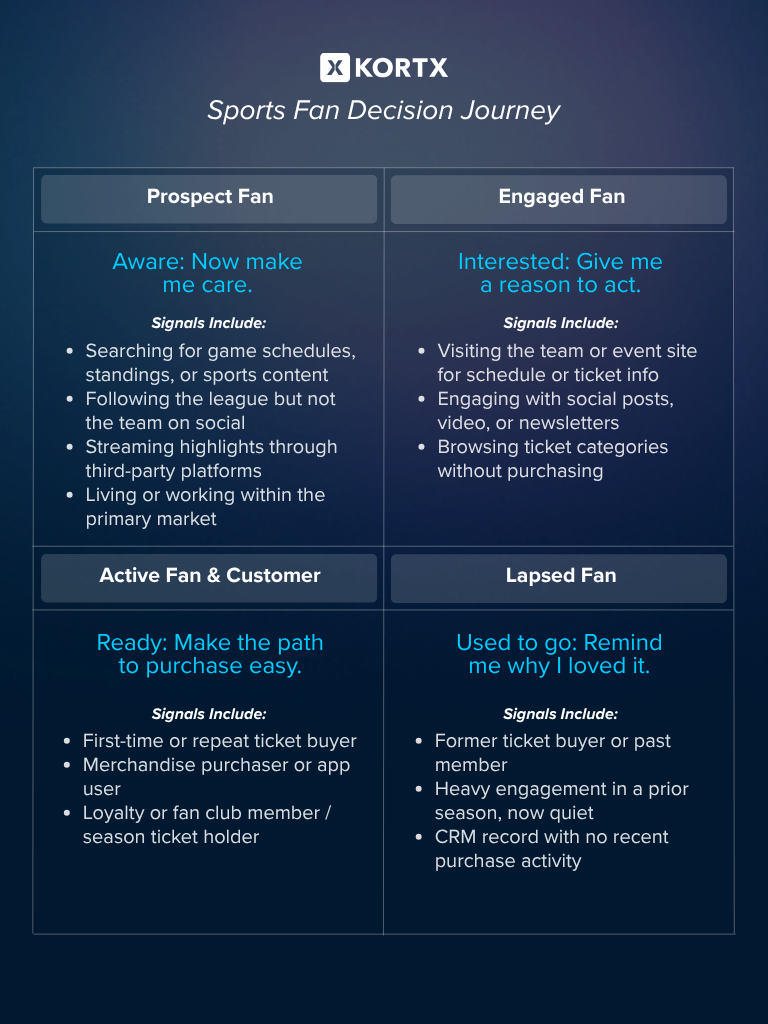
Sports fans don’t follow a linear path. A casual viewer can become a season ticket holder within a single playoff run. A lapsed fan can return after a single great moment on social media. Effective campaigns meet fans wherever they are in that journey, and move them forward.
Stage 1: Prospect Fan — Awareness and Discovery
These are people who are aware of your sport, team, or brand but haven’t engaged with your organization directly. They might follow the league, watch highlights, or live within your market without having attended a game or made a purchase.
Typical signals include:
- Searching for game schedules, team standings, or sport-related content
- Following league accounts on social but not the team
- Streaming games or highlights through third-party platforms
- Living or working within the team’s primary market
Advertising strategy: Build recognition before the ask. Connected TV and online video introducing the team, season, or live event experience; short-form social content featuring highlights, fan atmosphere, and athlete personality; native and display placements in sports media, entertainment, and lifestyle environments.
Goal: Enter the fan’s consideration set before they’re actively looking for a ticket.
Stage 2: Engaged Fan — Consideration and Interest
These fans follow the team, interact with content, and have expressed intent — visiting your site, checking the schedule, browsing ticket options — without converting. They’re interested but they need a reason to act.
Typical signals include:
- Visiting the team or event website for schedule or ticket info
- Engaging with social posts, watching video content, or subscribing to a newsletter
- Browsing ticket categories without purchasing
Advertising strategy: Move from awareness to consideration with specificity. Retargeting campaigns featuring upcoming home games, seat availability, or promotional offers; interactive units like opponent-specific creative, “Pick your game” prompts, or limited-time offers; email and SMS capture through early access, giveaways, or presale events.
Goal: Convert passive interest into active purchase intent.
Stage 3: Active Fan and Customer — Conversion
These are fans who are ready to buy, or have bought before and are primed to buy again. They include first-time ticket buyers, merchandise purchasers, app users, and members of your loyalty or fan club programs. They are your highest-value segment.
Advertising strategy: Remove friction and create urgency. Dynamic creative featuring specific game matchups, remaining seat availability, or time-sensitive offers; geo-fencing around the stadium or competing entertainment venues; click-to-purchase or click-to-app install ads with clear, direct calls to action.
Goal: Drive the transaction — ticket, merchandise, membership, or renewal.
Stage 4: Lapsed Fan — Reactivation
These are former ticket buyers, past members, or fans who engaged heavily in a prior season but have since gone quiet. They represent one of the most cost-efficient opportunities in sports marketing because the affinity already exists.
Advertising strategy: Lead with nostalgia, novelty, or a reason to return. Special offers tied to a milestone game or fan appreciation event; CRM-based retargeting using first-party data from past purchases; lookalike modeling built from active, high-value fans to find new prospects with similar profiles.
Goal: Reactivate lapsed fans and reduce season-over-season attrition.
How to Build a Sports Audience Strategy
The total addressable market in sports can look enormous. Millions of fans, regional and national reach, multiple demographic profiles, but treating sports as mass marketing is where most programs fail. The fans most likely to buy a ticket this week are a much smaller, more predictable group than “people who like sports.”
At KORTX, we use an audience-first framework to help sports brands and agencies define the real addressable opportunity and build toward it.
- First-party data activation. Ticket purchasers, loyalty members, app users, and CRM contacts are the foundation. We use these audiences to retarget lapsed fans, build lookalike models, and suppress active buyers from prospecting spend, so no dollar is wasted reaching someone already in the funnel.
- Behavioral and intent segmentation. We segment beyond demographics, distinguishing the heavy home-game attendee from the digital-only viewer, the family planning a birthday outing from the season ticket holder shopping for an upgrade. Each segment gets a different message, a different channel mix, and a different call to action.
- Geographic precision. Sports audiences are layered geographically: local market fans who drive conversion, secondary drive-market fans who attend select games, and national or international fan bases who engage digitally and purchase merchandise. Campaign budgets and channels should reflect those tiers.
- Intent and contextual signals. Search behavior around “[team] tickets,” streaming of recent highlights, athlete-related searches, and sports media consumption all indicate high-intent audiences worth prioritizing with conversion-focused creative.
- Dynamic exclusion. We actively manage audience suppression, excluding current season ticket holders from prospecting campaigns, excluding recent purchasers from urgency-based creative, and reserving specific budgets for the lapsed and prospective fan segments most likely to deliver incremental revenue.
- KORTX Intelligence. Built on more than a decade of campaign performance data across 10,000+ campaigns, 1 billion+ user records, and 15,000+ audience attributes, helps us move from audience hypothesis to audience confidence before a campaign launches.
Sports Advertising Funnel Strategy
Sports campaigns must flex with the season, but the funnel structure is consistent. The organizations that perform year over year are the ones that show up at every stage, building awareness before the season opens, converting during peak demand, and retaining fans after the final buzzer.
Top-of-Funnel: Build Awareness and Fan Community
Tactics include CTV and online video that tell the team or event story — player profiles, fan atmosphere, season launch campaigns; short-form social video on TikTok, Instagram Reels, and YouTube Shorts; native and display placements in sports media, fantasy platforms, and local entertainment environments; audio advertising reaching fans during commute and game-day preparation windows.
The goal is to build brand presence and fan affinity before the high-intent purchasing window opens.
Mid-Funnel: Drive Consideration and Engagement
Tactics include retargeting for fans who visited ticket or event pages without purchasing; interactive ad units featuring upcoming game matchups, opponent-specific creative, or “pick your game” prompts; email and SMS capture through presales, early access offers, or fan club enrollment; dynamic creative that updates to reflect the schedule, win-loss record, or playoff standing.
The goal is to stay relevant during the consideration phase and make the next game feel like the obvious choice.
Lower-Funnel: Convert Interest into Revenue
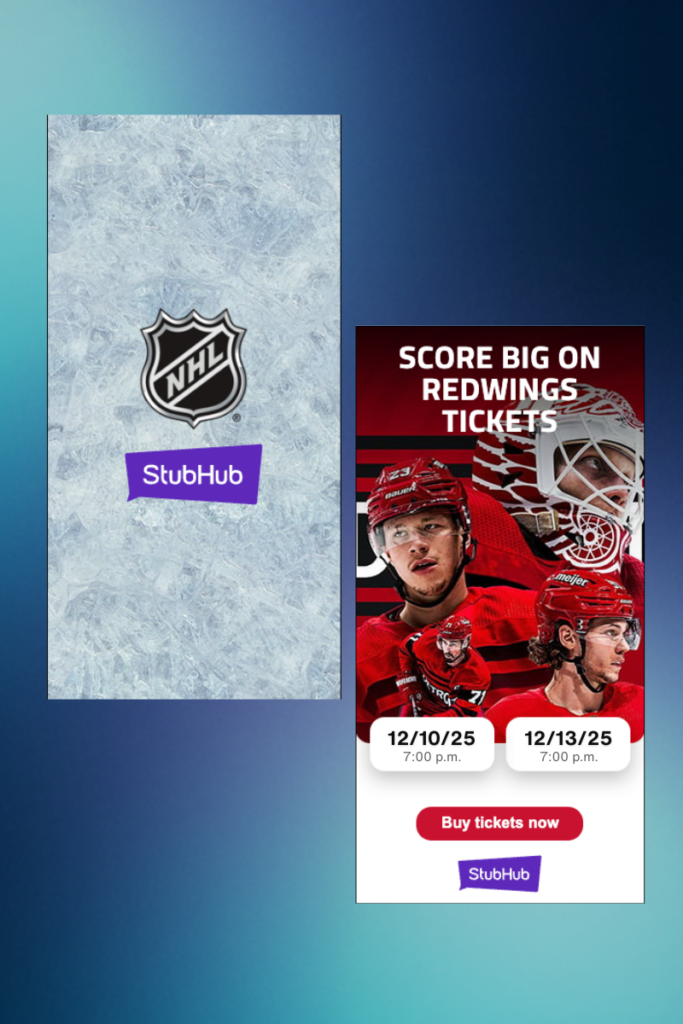
Tactics include dynamic creative tied to seat availability, time-limited offers, or upcoming matchup significance; geo-fencing around the venue and nearby entertainment zones during game-day windows; click-to-purchase ads connecting directly to the ticketing platform; mobile-first creative with clear, singular calls to action.
The goal is to make the path from intent to purchase as short as possible.
Post-Season and Retention: Build the Next Season’s Fan Base
Tactics include early-bird renewal campaigns for season ticket holders; loyalty program activation featuring exclusive access, behind-the-scenes content, and referral incentives; fan-generated content campaigns and social amplification programs; CRM-based reactivation sequences for lapsed buyers ahead of the next season opener.
The goal is to increase season-over-season retention, reduce churn among high-value fans, and deepen the community that drives long-term revenue.
Sports Creative Strategy: Emotion, Urgency, and Authenticity
In sports advertising, creative isn’t brand expression — it’s a performance lever. The visual, the message, and the moment together determine whether a fan buys a ticket or scrolls past. The most effective sports creative shares a few consistent traits.
- It leads with the moment, not the logo. Game atmosphere, crowd energy, athlete personality, and rivalry intensity consistently outperform product-first creative in sports categories.
- It uses authentic visuals. Real fans in real seats, actual game footage, genuine reactions — not stock photography. Fans know the difference, and they respond to it.
- It speaks to identity, not just offers. “This is our city. This is our team.” outperforms a generic discount message because fans make decisions based on belonging, not just price.
- It creates urgency through specificity. “3 games left at home this month” outperforms “Get tickets.” Game-specific creative — opponent, date, significance — converts at meaningfully higher rates than generic event advertising.
- It adapts to the moment. Dynamic creative that responds to game outcomes, playoff standings, or win streaks captures the fan when emotional investment is highest. The morning after a big win is one of the highest-converting windows in sports marketing.
Formats that consistently perform include opponent-specific dynamic display and video; short-form vertical video for social and pre-roll; behind-the-scenes and athlete access content for mid-funnel engagement; interactive rich media featuring seat selection, game schedule browsers, and “choose your game” units; geo-targeted mobile ads activated during game-day windows.
The Sports Marketing Calendar
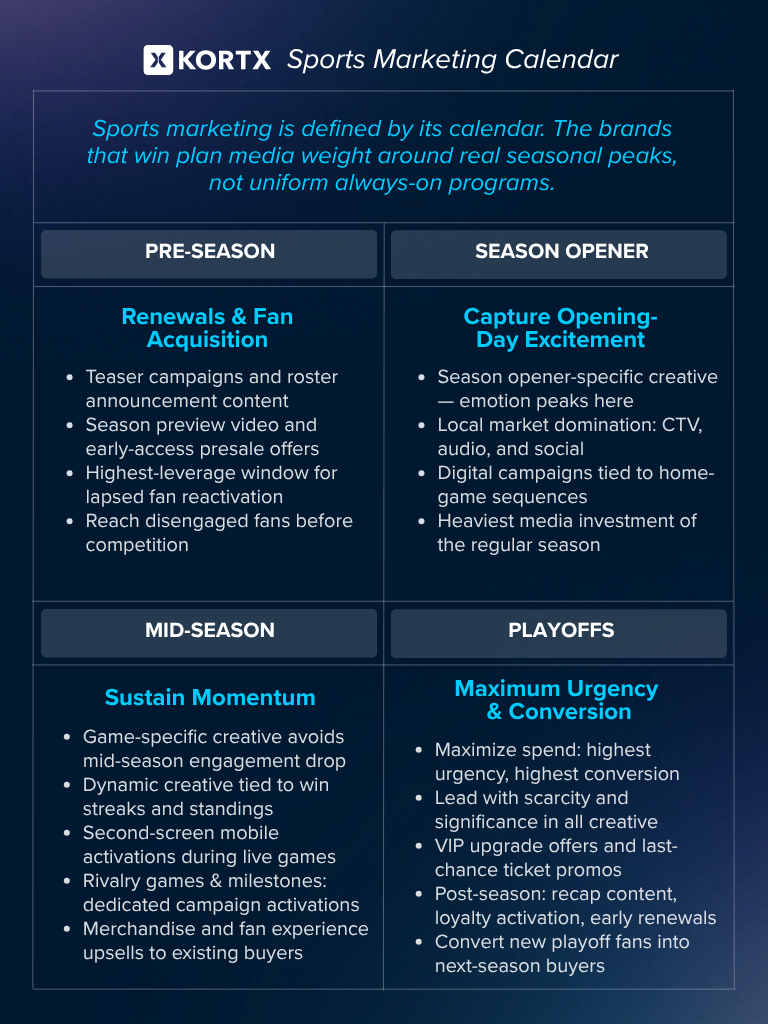
Sports marketing is defined by its calendar. Unlike most verticals, the demand curve is known in advance — and the brands that plan media weight around it, rather than running always-on programs at uniform spend, consistently outperform.
- Pre-Season and Off-Season Focus on renewals, early-bird offers, and fan acquisition before in-season competition for attention begins. Tactics include teaser campaigns, training camp and roster announcement content, season preview video, and early-access presale offers for returning fans. This is also the highest-leverage window for reactivation — reaching lapsed fans before they make commitments to competing entertainment options.
- Regular Season — Opening Weeks Season launch is a high-emotion, high-intent moment. Media investment should be heaviest here to capture fans riding opening-day excitement. Tactics include season opener-specific creative, local market domination across CTV, audio, and social, and digital campaigns tied to home-game sequences.
- Regular Season — Mid-Season The mid-season is where programs most often lose momentum. Sustain engagement with game-specific creative, dynamic creative tied to win streaks or standings, and second-screen mobile activations during games. This is also the right window to push merchandise and fan experience upsells to existing buyers.
- High-Intensity Moments: Rivalry Games, Milestones, and Events These moments warrant their own campaign activations. A rivalry game or athlete milestone creates urgency that generic always-on campaigns can’t replicate. Allocate incremental budget for these windows and build creative specifically for them — the conversion rates justify the investment.
- Playoffs and Championship Runs Playoff racing is the highest-urgency, highest-conversion period in sports marketing. Maximize spend, minimize friction, and lead with scarcity and significance. VIP upgrade offers, last-chance ticket promos, and social amplification campaigns all perform exceptionally well.
- Post-Season and Off-Season Retain attention with season recap content, loyalty program activation, early renewal incentives, and community-building campaigns. Introduce new fans acquired during playoff runs to your year-round ecosystem so they’re active buyers when the next season opens.
Also layer in micro-moments throughout: athlete announcements, trade and roster news, major award recognitions, milestone game celebrations, and sponsor activation windows. These organic moments of fan attention are among the most efficient media opportunities available — if you have a program ready to activate quickly.
How to Measure Sports Advertising Performance
Sports brands aren’t buying impressions. They’re filling seats, renewing memberships, driving merchandise revenue, and delivering measurable value to sponsors. Measurement frameworks need to reflect those outcomes.
At KORTX, we connect media investment to the metrics that matter most to sports business operations.
The metrics we track include:
- Tickets sold per game, event, and campaign — with cost-per-ticket acquisition calculated across channels
- Membership activations and renewals, including early-renewal rates influenced by media
- Merchandise revenue tied to campaign windows and creative themes
- App downloads and in-app purchase activity driven by paid media
- Digital engagement: video completion rates, social shares, email open and conversion rates
- Fan lifetime value: how media-acquired fans perform across seasons — repeat attendance, merchandise spend, referral behavior
- Sponsorship value delivery: how media programs amplify partner visibility and demonstrate ROI to brands
- Cross-channel lift: the measurable impact of digital campaigns on in-venue performance
For agencies, we build reporting infrastructure that connects campaign performance to client business outcomes — making it straightforward to demonstrate media’s contribution to ticket revenue, partnership value, and fan retention in client reviews.
The KORTX analytics dashboard provides real-time visibility into campaign performance across all channels, with the ability to optimize spend toward the placements and audiences driving actual revenue — not just impressions.
How KORTX Helps Sports Brands and Agencies
Sports advertising rewards brands that combine audience precision, full-funnel activation, and dynamic creative built around real sporting moments. KORTX partners with sports organizations and the agencies that serve them to deliver:
- Audience-first targeting built from first-party data, behavioral signals, and KORTX Intelligence across 1B+ user records and 15,000+ audience attributes
- Full-funnel media activation across CTV, programmatic, paid social, audio, DOOH, and paid search — coordinated around the sports calendar
- Dynamic creative strategies that adapt to game results, playoff standings, opponent matchups, and event-specific moments
- Measurement frameworks that connect media spend to tickets sold, memberships activated, and sponsor value delivered
- Agency partnership infrastructure including white-label reporting, client-ready dashboards, and dedicated strategic support
The result is advertising that moves fans through the funnel — from casual awareness to active buyer to loyal advocate — with outcomes tied to the metrics sports organizations actually care about.
Final Takeaway: The Brands That Show Up in the Moment Win
Sports marketing is not about being everywhere. It’s about being in the right place — the right platform, the right creative, the right moment — when fan emotion is highest and purchase intent is real.
The teams, venues, and sports brands that fill seats and build lasting fan communities are the ones who treat audience intelligence as a competitive advantage, align media investment to the rhythms of the season, and build creative that speaks to identity and urgency in equal measure.
At KORTX, we’ve helped organizations across professional sports, motorsports, and live events build exactly that kind of program — one that converts passion into purchase and first-time buyers into long-term fans.
Frequently Asked Questions
What is sports marketing?
Sports marketing is the strategy and execution of paid, owned, and earned media designed to drive fan engagement, ticket sales, merchandise revenue, and sponsorship value for sports organizations, teams, venues, and sports-adjacent brands. Effective sports marketing combines audience targeting, seasonal campaign strategy, dynamic creative tied to game moments, and measurement that connects advertising to business outcomes like tickets sold and membership renewals.
Unlike most consumer categories, sports marketing operates on a known calendar with predictable peaks of fan interest and purchasing intent. The brands that perform are the ones that plan media investment around those peaks — rivalry games, playoff pushes, season openers — rather than running uniform campaigns year-round.
How is sports advertising different from other verticals?
Sports advertising is defined by three characteristics that most other categories don’t share. First, the audience is emotionally pre-qualified — fans already have identity and loyalty tied to the team or sport, which creates a different baseline for messaging than cold audience prospecting. Second, timing is a primary performance driver. A campaign running the 48 hours before a rivalry game or the morning after a big win will outperform the same creative running mid-week in a quiet part of the season. Third, the marketing calendar is largely fixed in advance, which means brands that plan creative and media weight around the schedule — rather than reactively — consistently outperform those that don’t.
For agencies managing sports accounts, these dynamics mean campaign planning should be structured around the season calendar from the start, not adapted after the fact.
What is the best media mix for sports advertising?
A high-performing sports media mix typically combines connected TV and online video for storytelling and reach, paid social for fan engagement and conversion, programmatic display and dynamic creative for retargeting and game-specific offers, audio advertising for game-day and commute windows, DOOH for local market presence around venues and high-traffic areas, and paid search to capture fans actively looking for tickets or event information.
The right balance depends on the sport, market size, and campaign objective. Awareness and fan acquisition campaigns lean toward CTV, social video, and audio. Conversion-led campaigns prioritize dynamic display, retargeting, geo-targeted mobile, and search. Retention and loyalty campaigns rely on CRM-based audiences, app messaging, and lookalike modeling from high-value fan segments.
How do you measure the impact of sports advertising on ticket sales?
Sports advertising performance is measured through a combination of click-based conversions, CRM matchbacks, and platform integrations with ticketing systems. For digital channels, click-to-purchase attribution provides direct measurement of media-driven ticket transactions. For broader campaign impact, we use exposure-based modeling that compares purchase behavior among ad-exposed audiences against a matched control group.
For agencies, we build reporting that surfaces cost-per-ticket-sold by channel, campaign, and creative unit — giving clients and their stakeholders a clear view of media’s contribution to revenue rather than just awareness or click metrics.
How should sports organizations plan advertising around the season calendar?
The most effective approach treats each phase of the season as its own campaign moment with distinct audience priorities, creative themes, and budget allocations. Pre-season should focus on renewals and early acquisition among the most engaged fan segments. Early regular season captures fans riding opening-day excitement. Mid-season requires active maintenance to sustain engagement during lower-intensity periods. High-stakes moments — rivalry games, milestones, playoff races — warrant dedicated budget and creative. Post-season focuses on retention and early pipeline for the following year.
Within that structure, layer in micro-moments: roster announcements, athlete milestones, winning streaks, and sponsor activation windows. These organic spikes in fan attention are among the most efficient conversion opportunities available — provided you have a program ready to act quickly.
How does KORTX approach sports advertising for agencies?
KORTX works as a strategic and executional partner for agencies managing sports brand accounts. We bring audience intelligence built on more than a decade of sports campaign performance data, full-funnel media execution across all relevant channels, dynamic creative capabilities that adapt to game results and schedule moments, and analytics infrastructure that produces client-ready reporting tied to business outcomes.
For agencies, that means access to KORTX Intelligence — 1B+ user records, 15,000+ audience attributes, and 10,000+ campaign benchmarks — applied to your clients’ specific fan segments and market conditions. We’re built to function as a seamless extension of your team, not a separate vendor relationship to manage.