



TL;DR: Restaurant marketing in 2026 is shaped by hyperlocal audience strategy, real-time intent signals, and creative that converts cravings into orders. Brands that align media to daypart, location, and behavior — across CTV, social, programmatic, and search — will outperform those relying on broad reach or generic promotions.
Restaurant decisions happen fast. A search for “lunch near me,” a TikTok scroll past a melty cheese pull, a delivery app open on the couch, most of these moments resolve within minutes, not days. For QSR and fast-casual brands, that compressed decision window is both the challenge and the opportunity. Reaching a hungry customer with the right message, in the right moment, at the right location is what separates the brands that drive incremental orders from the ones that simply pay for impressions.
At KORTX, we help restaurant brands and agencies translate audience intelligence into measurable outcomes — foot traffic, mobile orders, app activations, and repeat visits. This playbook outlines how modern restaurant marketers approach audience strategy, full-funnel media activation, creative development, and measurement in a category where every meal is a competitive event.
What Makes Restaurant Marketing Different
Restaurant marketing operates under a different set of rules than most categories. The total addressable audience is broad — almost everyone eats — but the moment of decision is narrow, hyperlocal, and emotionally driven. A campaign that drives strong brand recall but doesn’t reach customers within range of a location, or during a relevant daypart, will struggle to convert.
A few realities define how effective restaurant advertising should be planned:
- Decision windows are short. From craving to commitment, most QSR and fast-casual purchases resolve in under thirty minutes. Media must be present in the moment, not just over time.
- Location is the conversion lever. A customer twenty minutes from a location behaves very differently than one within a five-minute drive. Geographic precision shapes both targeting and creative.
- Daypart matters more than demographics. The same person makes different decisions at 7 a.m., 12 p.m., and 10 p.m. Effective campaigns segment by meal occasion, not just by who the customer is.
- Third-party platforms own a meaningful share of the journey. DoorDash, Uber Eats, and Grubhub influence consideration and conversion. Brands need a strategy for both their owned channels and the marketplaces customers use to discover and order.
- Loyalty and frequency drive long-term value. The first order is rarely the most profitable one. Programs that activate repeat behavior — through apps, CRM, and lifecycle messaging — compound over time.
Because of these dynamics, restaurant advertising rewards precision over reach. The brands that win are the ones that align audience, location, daypart, and creative around real-time decision moments.
Understanding the Restaurant Customer Journey
Even though restaurant decisions move quickly, the journey still has distinct stages. Each one calls for its own audience definition, message, and channel strategy.
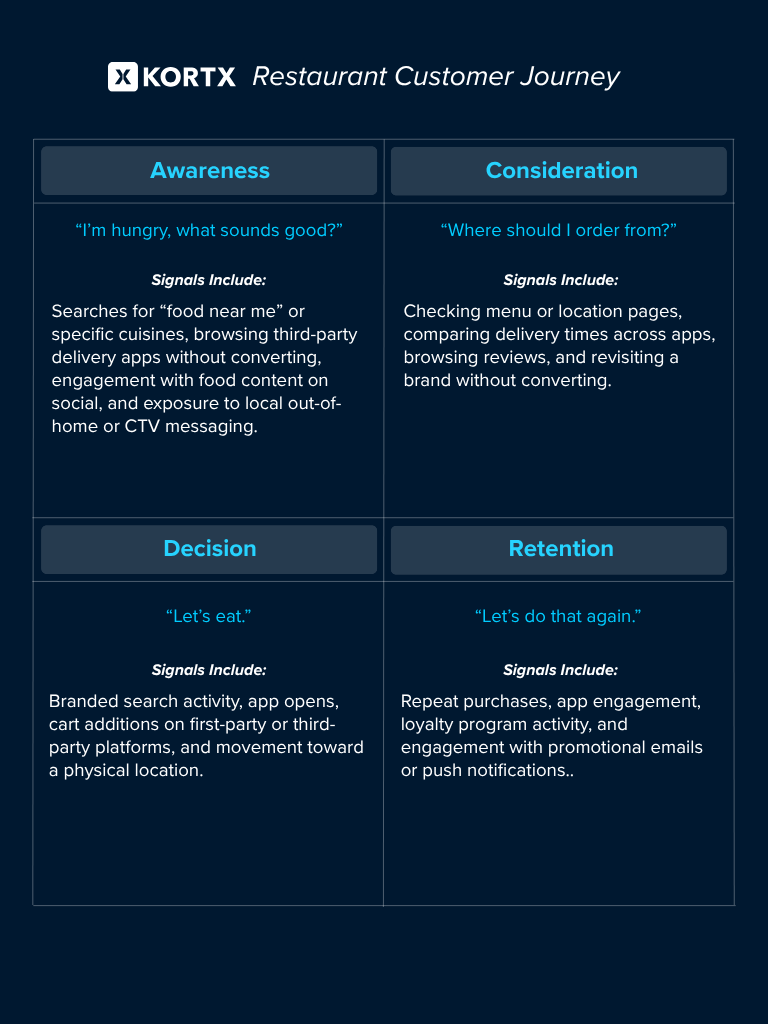
Stage 1: Awareness — “I’m hungry, what sounds good?”
At this stage, customers are open to options but haven’t chosen a brand. They’re searching cuisine types, scrolling delivery apps, watching food content on TikTok or YouTube, or noticing nearby signage on the way home.
Typical signals include searches for “food near me” or specific cuisines, browsing third-party delivery apps without converting, engagement with food content on social, and exposure to local out-of-home or CTV messaging.
The advertising strategy here focuses on building recognition and stimulating cravings: connected TV and online video that show the food in motion, paid social with short-form video, native placements in food and lifestyle environments, and proximity-based display targeting nearby audiences.
The goal is to enter the consideration set before the decision is made.
Stage 2: Consideration — “Where should I order from?”
Once a customer has decided they want to eat, they begin comparing options. Speed, price, menu fit, reviews, and promotions all factor into the choice.
Typical signals include checking menu or location pages, comparing delivery times across apps, browsing reviews, and revisiting a brand without converting.
The advertising strategy at this stage shifts to retargeting and reinforcement: dynamic creative featuring promotions, menu items, or limited-time offers; geo-targeted messaging tied to nearby locations; and rich media that surfaces price points or combos.
The goal is to make the brand the obvious choice when the customer is ready to commit.
Stage 3: Conversion — “Let’s eat.”
At the decision point, friction is the enemy. Every additional click, scroll, or step is a chance to lose the order.
Typical signals include branded search activity, app opens, cart additions on first-party or third-party platforms, and movement toward a physical location.
The advertising strategy is built around removing friction: click-to-order ads, click-to-map calls-to-action, app download incentives, in-app offers tied to location and daypart, and dynamic creative that adjusts to the customer’s distance from the nearest store.
The goal is to shorten the path from interest to order.
Stage 4: Loyalty and Frequency — “Let’s do that again.”
For restaurant brands, the first order is the start of the relationship, not the end. Loyalty drives lifetime value, and lifetime value drives the economics of the category.
Typical signals include repeat purchases, app engagement, loyalty program activity, and engagement with promotional emails or push notifications.
The advertising strategy focuses on activation and re-engagement: CRM-based retargeting, app-installed audience messaging, loyalty sequence ads, and lookalike modeling built from high-frequency customers.
The goal is to increase visit frequency, basket size, and long-term customer value.
How to Build a Restaurant Audience Strategy
In a category where everyone eats, audience strategy is what separates wasted impressions from incremental orders. The total addressable market may be broad, but the addressable opportunity at any given moment is shaped by location, daypart, intent, and behavior.
At KORTX, we use an audience-first framework to help restaurant brands reach the right customers when they’re most likely to act.
Radius and trade-area modeling. We define each location’s true trade area based on actual customer travel patterns, competitive density, and time-of-day movement, not just generic radii. This ensures media is concentrated where it can drive measurable visit lift.
First-party data activation. App users, loyalty members, and CRM contacts power both retargeting and lookalike modeling. We use these audiences to re-engage lapsed customers and identify high-value prospects who behave like top loyalty members.
Daypart and meal-occasion segmentation. Breakfast commuters, lunch decision-makers, weekend families, and late-night audiences are different segments with different needs. Campaigns are built around meal occasions, with creative and targeting that reflect each window.
Delivery platform intelligence. Audiences who order from DoorDash, Uber Eats, or Grubhub but haven’t ordered from a specific brand represent a high-value conversion opportunity. Targeting these users with brand-specific offers can drive incremental trial.
Behavioral and contextual layering. Recent interest in food categories, dining content, or local entertainment helps refine targeting beyond demographics. Contextual placements alongside food and lifestyle content reinforce relevance.
Competitive conquesting. For multi-location brands, geo-fencing competitor locations during peak dayparts can capture customers who are already in a buying mindset.
In a category this competitive, precision is what creates performance.
Restaurant Marketing Funnel Strategy
Restaurant campaigns must move quickly, but they still benefit from a clear funnel. The brands that perform consistently are the ones that show up across awareness, consideration, conversion, and loyalty, with each stage reinforcing the next.
Top-of-Funnel: Build Cravings and Recognition
Tactics include connected TV and online video featuring food in motion, short-form video on TikTok, Instagram Reels, and YouTube Shorts, influencer and creator partnerships that drive local relevance, and contextual display in food, lifestyle, and entertainment environments.
The goal is to build brand recognition and create craving cues that customers carry into their next decision moment.
Mid-Funnel: Drive Consideration and Preference
Tactics include retargeting based on menu views, location lookups, or app activity; geo-targeted creative promoting location-specific offers; native and rich media ads featuring scrollable menus, combos, or limited-time items; and email and SMS capture for ongoing engagement.
The goal is to stay top of mind as customers compare options and move toward a decision.
Lower-Funnel: Convert Cravings into Orders
Tactics include click-to-order and click-to-map ads on search and display, dynamic proximity targeting that activates when audiences are near a location during peak dayparts, app download incentives with first-time order offers, and countdown messaging tied to limited-time promotions.
The goal is to make the path from impression to order as short as possible.
Loyalty: Drive Frequency and Lifetime Value
Tactics include CRM-based retargeting tied to recency and frequency, app-engagement campaigns featuring new menu items or rewards, loyalty program activation sequences, and lookalike audiences built from high-frequency customers.
The goal is to grow visit frequency, basket size, and long-term customer value.
Restaurant Creative Strategy: Messaging That Drives Action
In restaurant marketing, creative is performance media. The visual, the offer, and the call-to-action together determine whether a customer scrolls past or places an order. The most effective restaurant advertising shares a few common traits.
- It leads with the food, not the logo. Close, well-lit, motion-driven shots of menu items consistently outperform brand-led creative in this category.
- It uses motion. Short-form video — pours, drizzles, bites, sizzles — converts better than static creative across nearly every placement.
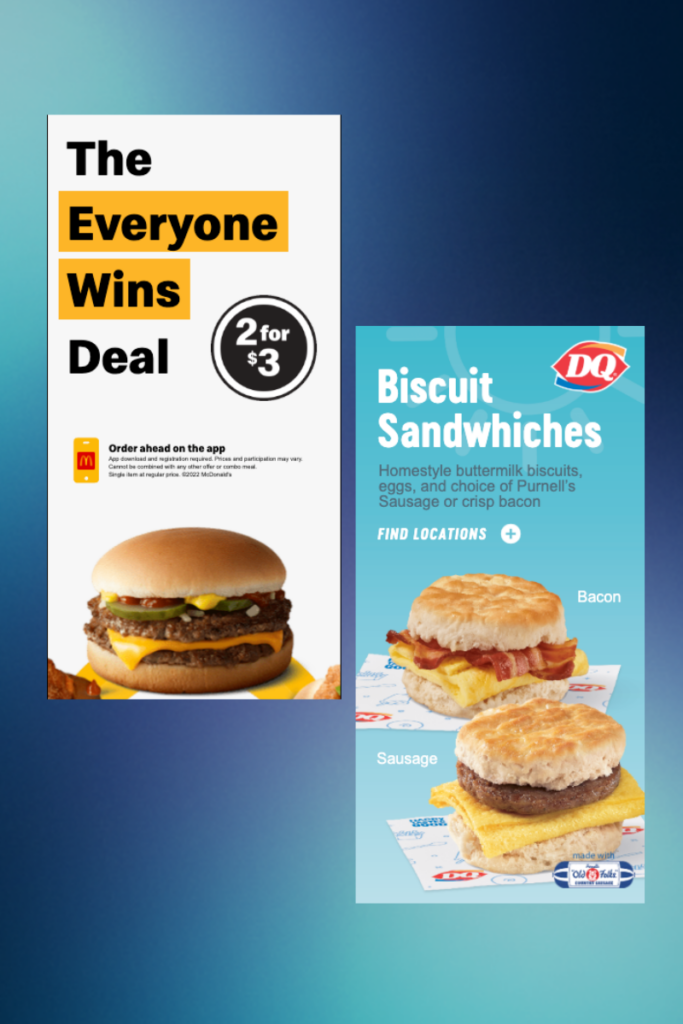
- It is specific and immediate. “2 for $5 through Sunday” outperforms “great deals all month.” Specificity creates urgency.
- It optimizes for mobile. The majority of restaurant decisions happen on a phone. Vertical video, bold headlines, and tap-to-order calls-to-action are essential.
- It adapts by location and daypart. Dynamic creative that adjusts to the nearest location, current wait time, or relevant meal occasion drives meaningfully higher conversion than static creative.
Formats that consistently perform include short-form vertical video for social and pre-roll, shoppable rich media featuring menu items and delivery partners, dynamic display with store-specific addresses or live offers, and mobile-first creative with tap-to-call, tap-to-map, and tap-to-order functionality.
The Restaurant Marketing Calendar
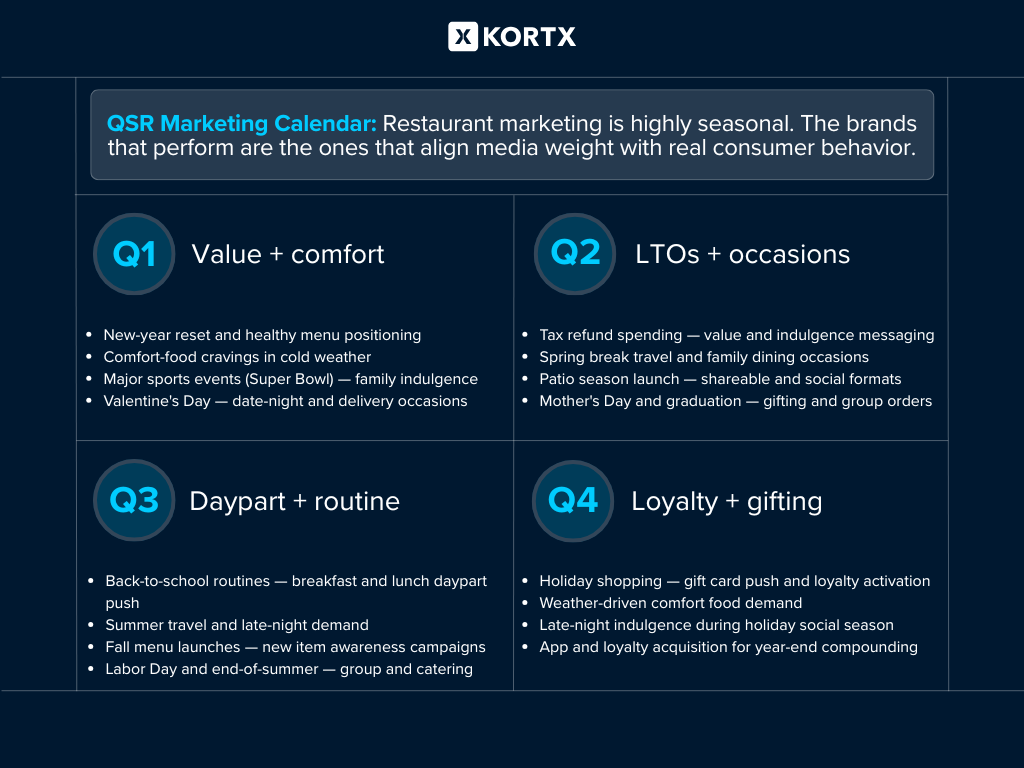
Restaurant marketing is highly seasonal, but the patterns extend well beyond the standard fiscal calendar. The brands that perform are the ones that align media weight with real consumer behavior.
The first quarter is shaped by new-year resets, comfort-food cravings, and family-focused indulgence around major sports events. Healthy menu items and value messaging tend to perform well.
The second quarter is driven by tax refund spending, spring break travel, and the start of grilling and patio season. Limited-time offers and family-occasion messaging take priority.
The third quarter centers on back-to-school routines, summer travel, late-night demand, and fall menu launches. Daypart strategy matters more than ever as customer behavior fragments across new schedules.
The fourth quarter is defined by holiday shopping, gifting through gift cards, late-night indulgence, and weather-driven comfort food demand. Loyalty and app activation can compound meaningfully through this period.
Beyond the quarterly view, restaurant calendars should account for cultural and micro-moments — local sports events, weather triggers, day-of-week patterns like Taco Tuesday or weekend brunch, and limited-time menu launches that create their own demand spikes.
How to Measure Restaurant Advertising Performance
Restaurant brands aren’t buying impressions. They’re buying orders, visits, app installs, and repeat behavior. Measurement frameworks need to reflect that.
At KORTX, we connect media activity to outcomes through a combination of platform, behavioral, and first-party data sources.
The metrics that matter most include click-to-order conversions across owned and third-party platforms, store visitation lift measured through location-data partners, coupon and promo code redemption tied back to specific campaigns, app downloads and first-purchase activity, CRM and loyalty matchbacks linking media exposure to long-term customer value, and return on ad spend by location, menu item, or campaign.
We also integrate with major POS, ordering, and loyalty platforms to close the loop between media spend and operational outcomes — making it possible to measure not just whether advertising drove a visit, but whether it drove a profitable one.
How KORTX Helps Restaurant and QSR Brands
Restaurant marketing rewards brands that combine audience precision, full-funnel activation, and outcome-based measurement. KORTX partners with restaurant brands and agencies to deliver:
- Audience-first targeting strategies built around location, daypart, and first-party data.
- Full-funnel media activation across CTV, programmatic, social, search, and audio. ‘
- Creative strategies that adapt to location, menu, and meal occasion.
- Measurement frameworks that connect media investment to orders, visits, and repeat behavior.
The result is advertising that does more than build awareness. It moves customers from craving to order, and from first visit to lasting loyalty.
Final Takeaway: The Brands That Show Up Win
In restaurant marketing, timing, trust, and visibility matter more than ever. Customers make fast decisions, often within a few miles of where they already are, and rarely give a brand a second chance to be relevant. The brands that earn the order are the ones that show up in the right moment, with creative that converts cravings into action.
At KORTX, we help restaurant marketers do exactly that, by defining the right audiences, planning media around real customer behavior, and measuring impact through outcomes that matter to the business.
Frequently Asked Questions
What is restaurant marketing?
Restaurant marketing is the strategy and execution of paid, owned, and earned media designed to drive awareness, orders, visits, and loyalty for restaurant brands. Effective restaurant marketing combines audience targeting, location-based media, creative tailored to meal occasions, and measurement that ties advertising to real business outcomes like orders and store visits.
Modern restaurant marketing has shifted from broad-reach television and print toward audience-first digital strategies. Brands now use connected TV, programmatic, social media, and search to reach customers in the specific moments they’re most likely to make a decision, by location, daypart, and behavior.
How is restaurant marketing different from other industries?
Restaurant marketing differs from most categories in three important ways. First, decision windows are short — most QSR and fast-casual purchases resolve in under thirty minutes. Second, location is a primary conversion driver, which means proximity, trade area, and daypart often matter more than demographics. Third, third-party platforms like DoorDash, Uber Eats, and Grubhub play a meaningful role in both consideration and conversion, requiring a strategy that spans owned, paid, and marketplace channels.
These dynamics make restaurant advertising less about reach and more about precision. The brands that win are the ones that align audience, location, daypart, and creative around real-time decision moments.
What is the best media mix for a QSR or restaurant campaign?
A high-performing restaurant media mix typically combines connected TV for storytelling and reach, social video and short-form content for craving-driven engagement, programmatic display and rich media for retargeting and reinforcement, paid search for capturing high-intent demand, and audio for daypart-relevant impressions during commute and drive-thru windows.
The right balance depends on the brand, the geography, and the campaign goal. Awareness-led campaigns lean more heavily on CTV, social video, and audio. Conversion-led campaigns prioritize search, retargeting, and proximity-based display. Loyalty campaigns rely heavily on CRM, app-based audiences, and lookalike modeling. The most effective programs coordinate all of these channels around a clear customer journey.
How do you measure foot traffic and orders from digital advertising?
Restaurant advertising performance is measured through a combination of click-based conversions, location-data partnerships, CRM matchbacks, and loyalty program integrations. Foot traffic lift is typically measured by comparing visit rates among audiences exposed to advertising versus a matched control group, using mobile location data. Orders are measured through click-to-order conversions, promo code redemption, app first-purchase tracking, and POS integrations.
For brands with loyalty programs or first-party data, the most accurate measurement comes from matching ad-exposed audiences back to actual customer records — which makes it possible to attribute not just visits and orders, but long-term customer value.
How should restaurant brands plan around daypart and seasonality?
Restaurant marketing should be planned around meal occasions and seasonal behavior, not just monthly or quarterly budgets. Breakfast, lunch, dinner, and late-night audiences behave differently and should be reached with different creative, channels, and offers. Seasonally, the first quarter favors comfort and value, the second leans into limited-time offers and family occasions, the third emphasizes back-to-school routines and late-night demand, and the fourth is shaped by holidays, gift cards, and weather-driven comfort food.
The most effective campaigns layer these macro patterns with local triggers — sports events, weather, weekly day-of-week behaviors, and limited-time menu launches — to align media weight with real demand.
How does KORTX approach restaurant marketing?
KORTX approaches restaurant marketing through audience intelligence, building strategies grounded in how customers actually behave by location, daypart, and intent. Our process follows four connected steps: Audience → Insight → Messaging → Media. We define each location’s true trade area, segment customers by meal occasion and behavior, build creative that adapts to location and daypart, and measure outcomes through orders, visits, and loyalty rather than impressions alone.
This approach helps restaurant brands move beyond awareness-driven advertising and create campaigns that drive incremental orders, visits, and lifetime value across every location.
Let’s Build a More Profitable Restaurant Marketing Program
KORTX works with restaurant brands and agencies to translate audience insight into media that drives orders, visits, and repeat behavior. Curious how this could apply to your locations? Request a restaurant marketing strategy consultation → Let’s talk restaurant strategy.