



TL;DR: Hospitality and entertainment marketing works when it meets guests and attendees in the moment: daydreaming about a getaway, comparing dates and availability, or a click away from booking. Brands that combine first-party guest data, full-funnel strategy, and dynamic creative tied to real availability consistently outperform those relying on broad reach or one-off campaigns. This playbook covers how to build that program from the ground up.
A hotel room or a concert ticket is often a simple transaction on paper. But the decision behind it usually isn’t: the view from the balcony, the encore, the toast at last call are what someone’s actually weighing when they compare options. Hospitality and entertainment brands are competing with other properties and venues, but just as often they’re competing with a night in, a different city, or a cheaper ticket, every other way someone could spend that same weekend and that same dollar.
A generic “Book Now” campaign running in a quiet shoulder week performs very differently than a dynamic, countdown-driven ad showing “3 rooms left this weekend” to a drive-market audience during a sold-out concert weekend. Guests and attendees make decisions based on timing, availability, and the promise of a moment worth remembering, and the hospitality and entertainment brands that understand those drivers, and build media around them, are the ones filling rooms, filling seats, and building return visits.
At KORTX, we help hospitality and entertainment brands and the agencies that serve them turn audience intelligence into measurable outcomes: direct bookings, tickets sold, ancillary revenue, loyalty enrollments, and repeat guests season after season. We’ve built campaigns for hotels, resorts, event venues, attractions, and entertainment brands, and the patterns that drive performance are consistent.
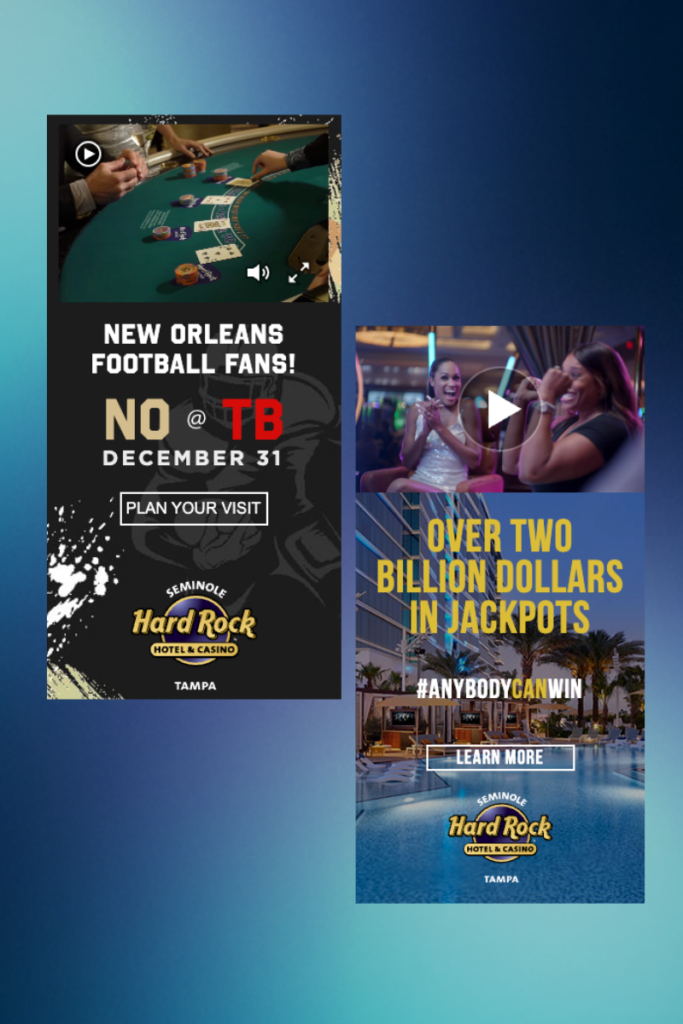
What Makes Hospitality & Entertainment Advertising Different
Hospitality and entertainment marketing operates under a distinct set of rules. The audience is broad, everyone travels, attends events, or looks for something to do, but that breadth is misleading. The brands that win connect the right guest to the right experience at the exact moment they’re ready to book.
A few realities define how effective hospitality and entertainment advertising must be planned:
- The product is intangible. Guests aren’t buying a room or a seat, they’re buying a feeling, a memory, a story worth sharing. Creative has to carry emotion the way a spec sheet never could.
- Timing and availability define demand. Seasonality, event dates, and inventory windows create sharp peaks and valleys, and brands that plan media around those cycles convert at a different rate than those running flat, always-on spend.
- Direct booking competes with aggregators. OTAs, ticket resellers, and event platforms sit between the brand and the guest at nearly every stage, which makes owning the direct relationship, and the direct booking, a real competitive advantage.
- Reviews and user-generated content carry the message. A guest’s photo, review, or story does more to move the next booking than brand-produced creative alone.
- The visit is the beginning, not the end. A satisfied guest is a loyalty member, a repeat booker, and a referral source. Programs that stop marketing at check-out or the final encore leave the highest-margin part of the relationship unbuilt.
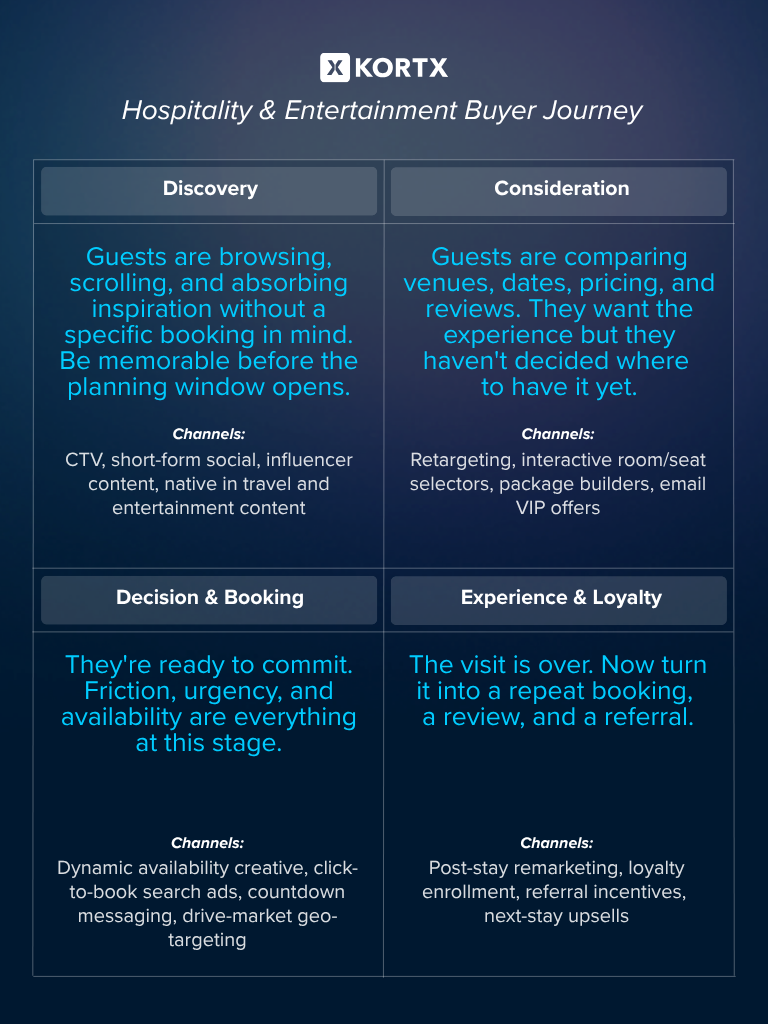
Understanding the Guest & Attendee Journey
When someone books a resort stay, a concert ticket, or a travel experience, they move through phases that look familiar on paper, but every touchpoint carries real weight. Effective campaigns meet guests and attendees wherever they are in that journey and move them toward a booking.
Stage 1: Discovery (Inspiration Phase)
These are potential guests or attendees browsing, daydreaming, or reacting to a life moment, a vacation window, an upcoming event, a change of season, without a specific booking in mind yet.
Typical signals include:
- Scrolling travel or event inspiration on social platforms or YouTube
- Searching broad terms like “weekend getaway near me,” “live music [city],” or “family resort summer”
- Viewing photo galleries, influencer posts, or travel and event blogs
Advertising strategy: Build emotional recognition before the planning window opens. High-impact video and CTV showing the destination, event, or experience story; native placements in travel, entertainment, and lifestyle content; short-form social video showcasing moments, behind-the-scenes footage, and influencer content.
Goal: Make the property, venue, or event top-of-mind before the guest starts actively planning.
Stage 2: Consideration (Comparison & Planning)
These guests are comparing venues, dates, pricing, availability, and reviews. They know they want the experience. They haven’t decided where to have it.
Typical signals include:
- Visiting booking pages, checking date availability, reading guest reviews, or browsing amenities
- Signing up for newsletters or reviewing package deals
- Comparing your direct site against an aggregator, OTA, or event platform
Advertising strategy: Move from interest to conviction with specificity. Retargeting based on site visits, availability checks, or contact form fills; interactive rich media like room and seat selectors or package builders; email and VIP-offer retargeting built around packages and upsells.
Goal: Give the guest a clear reason to book direct, with you, instead of through a third party.
Stage 3: Decision & Booking (Action)
These guests are ready to commit. They include instant bookers, ticket purchasers, and guests who started a booking flow but didn’t finish.
Typical signals include:
- “Book Now” clicks, “Add to Calendar” actions, ticket purchases, or hotel checkout flows
- Abandoned booking forms or repricing cycles
Advertising strategy: Remove friction and create urgency. Dynamic creative reflecting real availability, “only 3 rooms left this weekend,” countdown timers for event dates; click-to-book and seat-specific search ads; location-specific promos for drive-market and last-minute audiences.
Goal: Make the booking simple, immediate, and pleasurable.
Stage 4: Experience & Loyalty (Return or Recommend)
These are guests and attendees who’ve already had the experience. They represent the highest-value opportunity: repeat bookings, loyalty enrollment, and the reviews and referrals that drive the next guest’s discovery phase.
Typical signals include:
- Check-in behavior, app or UX engagement, review submission, or referral sharing
- Repeat bookings, loyalty or membership enrollment, or feedback survey completion
Advertising strategy: Lead with recognition and reward. Post-experience remarketing built around feedback requests, loyalty enrollment, and next-stay or next-event upsells; email and app messaging tied to milestones and membership tiers; referral incentives that turn a satisfied guest into a source of new bookings.
Goal: Turn a single stay or event into a lasting relationship, and a guest into an advocate.
How to Build a Hospitality & Entertainment Audience Strategy
The total addressable market in hospitality and entertainment can look limitless. Nearly everyone travels, attends events, or looks for something to do with their weekend. But treating that market as one audience is where most programs fail. The guests most likely to book this week are a much smaller, more predictable group than “people who like to travel or go out.”
At KORTX, we use an audience-first framework to help hospitality and entertainment brands and agencies define the real addressable opportunity and build toward it.
- First-party data activation. Past bookers, event attendees, and loyalty members are the foundation. We use these audiences to retarget high-propensity guests, build lookalike models, and suppress recent bookers from acquisition spend, so no dollar is wasted reaching someone already in the funnel.
- Behavioral and intent segmentation. We segment beyond demographics, distinguishing the business traveler from the leisure guest, the family booking a resort stay from the couple planning a weekend escape, the local ticket buyer from the destination attendee. Each segment gets a different message, a different channel mix, and a different call to action.
- Geographic and catchment targeting. Hospitality and entertainment audiences are layered by inbound tourist markets, drive-market proximity, and the natural catchment area around a venue or resort. Budgets and messaging should reflect those tiers.
- Intent and contextual signals. Travel search behavior, ticket search activity, destination content engagement, and local event interest all indicate high-intent guests worth prioritizing with conversion-focused creative.
- Dynamic exclusion. We actively manage audience suppression, excluding non-traveling or geographically unreachable segments and guests who’ve already booked, so budget concentrates on the audiences most likely to convert.
- KORTX Intelligence. Built on more than a decade of campaign performance data across 10,000+ campaigns, 1 billion+ user records, and 15,000+ audience attributes, including travel, event, and entertainment-specific behavioral and intent data, helps us move from audience hypothesis to audience confidence before a campaign launches.
Hospitality & Entertainment Advertising Funnel Strategy
Guests and attendees buy experiences on very different timelines, sometimes on impulse, sometimes months in advance. The brands that perform are the ones that show up at every stage: building desire before the planning window opens, converting during peak booking windows, and turning guests into repeat visitors after the experience ends.
Top-of-Funnel: Inspire and Capture Imagination
Tactics include high-impact video and CTV showing the destination, event, or experience story; native placements in travel, entertainment, and lifestyle content; short-form social video on Instagram and TikTok showcasing moments, behind-the-scenes footage, and influencer content.
The goal is to create aspiration, trigger interest, and seed consideration before the guest starts planning.
Mid-Funnel: Engage and Drive Planning
Tactics include retargeting based on site visits, availability checks, or contact form fills; interactive rich media like room and seat selectors or package builders; email and local-market retargeting built around packages, offers, and VIP upsells.
The goal is to move guests from “maybe” to “let’s plan this.”
Lower-Funnel: Book, Visit, and Repeat
Tactics include dynamic creative with real availability, countdowns, and urgency messaging; click-to-book and seat-specific search ads; location-specific promos for drive-market and last-minute audiences; post-experience remarketing built around feedback, loyalty enrollment, and next-stay upsells.
The goal is to make the booking simple, immediate, and pleasurable.
Post-Experience: Build Loyalty and Advocacy
Tactics include loyalty and membership activation featuring exclusive access and milestone rewards; review and referral prompts timed to peak satisfaction right after the experience; retargeting for future stays or events tied to new seasons, lineups, or offerings.
The goal is to turn a single visit into a lifetime relationship, and a guest into an advocate.
Hospitality & Entertainment Creative Strategy: Make It Feel Like the Experience
In hospitality and entertainment, creative has to carry the promise of the experience itself. It has to deliver emotion, clarity, and a reason to act, often before the guest has consciously decided they want to go anywhere at all.
- It shows the moment, not the amenity list. The view, the crowd, the toast, the applause, sell the feeling before you sell the features.
- It uses real guest and event imagery. Authentic photos and footage from actual stays and actual shows outperform staged stock in almost every test.
- It ties the call to action to the experience. “Book your sunrise view” and “Reserve your front-row seat” outperform generic “Book Now” messaging because they name the moment being purchased.
- It addresses the practical barriers. Price transparency, cancellation flexibility, and loyalty rewards remove the hesitation that emotion alone can’t overcome.
- It creates urgency through specificity. “Only 3 rooms left this weekend” and “Early bird pricing ends tonight” outperform static promotional messaging because they turn availability into a reason to act now.
Formats that consistently perform include short-form video (15-30 seconds) optimized for mobile and social; interactive media like room or seat selectors and experience comparison sliders; dynamic display with real-time availability, seasonality, and local triggers; content marketing like travel guides, event lineups, and destination blogs.
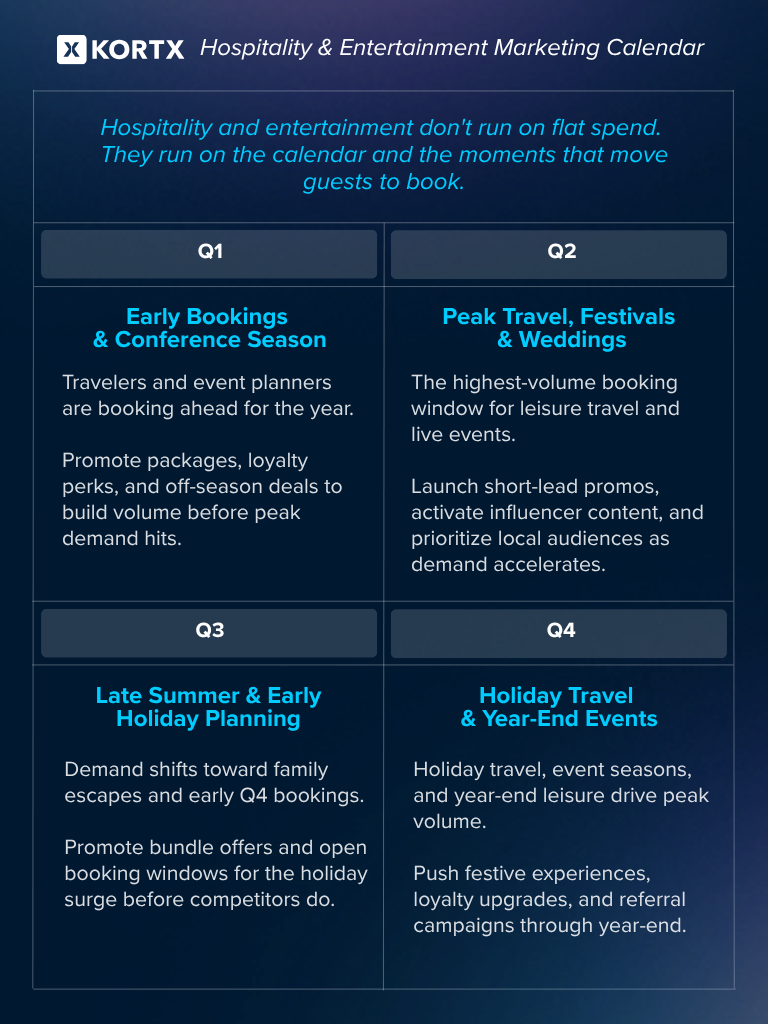
The Hospitality & Entertainment Marketing Calendar
Timing in hospitality and entertainment is everything. Campaigns need to map to seasonality, event dates, holidays, and travel trends, not run at uniform spend year-round.
- Q1: Early Bookings and Conference Season. Travelers and event planners are booking ahead for the year. Promote packages, loyalty days, and off-season deals to build volume before peak demand hits.
- Q2: Peak Travel, Festivals, and Weddings. The highest-volume booking window for leisure travel and live events. Launch short-lead promos, activate influencer trips, and prioritize local audience targeting as demand accelerates.
- Q3: Late Summer and Early Holiday Planning. Demand shifts toward family escapes and early holiday bookings. Promote bundle offers and open early booking windows for the Q4 surge.
- Q4: Holiday Travel and Year-End Events. Holiday travel, event seasons, and year-end leisure drive volume. Push festive experiences, loyalty upgrades, and referral campaigns through year-end.
Also layer in micro-moments throughout: major sporting and music events, local festivals, destination or venue openings, and last-minute inventory windows. Staying agile around these spikes is often where the most efficient bookings come from.
How to Measure Hospitality & Entertainment Advertising Performance
Hospitality and entertainment brands aren’t buying impressions. They’re filling rooms, filling seats, and building guests who come back. Measurement frameworks need to reflect the full path from inspiration to booking to loyalty.
The metrics we track include:
- Booking conversions: rooms reserved and tickets sold, by channel and campaign
- Cost per booking and cost per guest acquisition
- Guest and attendee lifetime value, and repeat-visit rate
- Post-stay or post-attendance engagement: loyalty enrollment, review submission, referral activity
- Incremental lift in direct bookings versus OTA or third-party channel bookings
- Ancillary revenue per stay or per event
For agencies, we build reporting infrastructure that connects campaign performance to client business outcomes, making it straightforward to demonstrate media’s contribution to bookings, direct revenue, and loyalty growth in client reviews.
How KORTX Helps Hospitality & Entertainment Brands and Agencies
Hospitality and entertainment advertising rewards brands that combine audience insight, full-funnel activation, and dynamic creative built around real guest behavior. KORTX partners with hotels, resorts, event venues, attractions, and entertainment brands, and the agencies that serve them, to deliver:
- Audience-first targeting built from first-party guest data, behavioral signals, and KORTX Intelligence across 1B+ user records and 15,000+ audience attributes, including travel, event, and entertainment-specific intent data
- Full-funnel omnichannel activation across CTV, programmatic, paid social, audio, and paid search, coordinated around booking windows, event dates, and seasonality
- Dynamic creative strategies that adapt to real-time availability, event countdowns, and local triggers like weather
- Measurement frameworks that connect media spend to bookings, ticket sales, ancillary revenue, and loyalty growth
- Agency partnership infrastructure including white-label reporting, client-ready dashboards, and dedicated strategic support
The result is advertising that moves guests and attendees through the funnel, from first daydream to booking to repeat visit, with outcomes tied to the metrics hospitality and entertainment brands actually care about.
Final Takeaway: Experience-Led Strategy Wins in Hospitality & Entertainment
Hospitality and entertainment marketing is not about reaching everyone who could theoretically travel or attend an event. It’s about reaching the guest who’s ready to book the moment, with a story that makes the decision feel effortless and an experience worth returning for.
The hotels, resorts, venues, and entertainment brands that fill rooms and fill seats consistently are the ones who treat audience intelligence as a competitive advantage, align media investment to the rhythms of the booking and event calendar, and build creative that earns emotion and urgency in equal measure.
At KORTX, we’ve helped hospitality and entertainment brands build exactly that kind of program: one that turns browsers into guests, attendees into advocates, and one-time visits into lifetime relationships.
Let’s talk hospitality and entertainment strategy →
Frequently Asked Questions
What is hospitality and entertainment advertising?
Hospitality and entertainment advertising is the strategy and execution of paid media designed to drive bookings, ticket sales, and loyalty for hotels, resorts, event venues, attractions, and entertainment brands. Effective hospitality and entertainment advertising combines audience targeting, full-funnel campaign strategy tied to the guest or attendee decision journey, creative that sells the experience rather than the amenity, and measurement that connects media investment to bookings, revenue, and repeat visits.
Unlike categories with simple, single-step purchases, hospitality and entertainment decisions often move through a distinct discovery, comparison, and booking process, sometimes compressed into a single impulsive decision and sometimes stretched across months of planning, which means campaigns need to reach guests at every stage.
How is hospitality and entertainment advertising different from other verticals?
Hospitality and entertainment advertising is defined by three characteristics that set it apart. First, the product is intangible. Guests are buying a feeling, a memory, or a story, which means creative has to carry emotional weight that a features list never could. Second, timing and inventory are structural. Seasonality, event dates, and room or seat availability create sharp demand peaks, and brands that plan media around those windows outperform those running flat, always-on spend. Third, the direct relationship competes with aggregators. OTAs, ticket resellers, and event platforms sit between the brand and the guest at nearly every stage, which makes winning the direct booking a meaningful competitive advantage.
What is the best media mix for hospitality and entertainment advertising?
A high-performing media mix typically combines CTV and high-impact video for destination, venue, or event storytelling, short-form social and influencer content for discovery and emotional engagement, programmatic display and dynamic creative for retargeting and availability-based conversion messaging, paid search to capture guests actively comparing options, and geo-targeted mobile for drive-market and last-minute conversion. The right balance depends on the property type, catchment area, and booking window. Inspiration-stage campaigns lean toward CTV, social video, and native content. Conversion-stage campaigns prioritize dynamic display, retargeting, and click-to-book search. Loyalty and advocacy campaigns rely on CRM-based email, app messaging, and referral-driven social.
How do you measure the impact of hospitality and entertainment advertising on bookings?
Connecting media to bookings requires a combination of direct and modeled attribution. Click-to-book tracking and platform integrations with reservation or ticketing systems provide direct measurement of media-driven bookings. For broader campaign impact, incremental lift modeling compares booking behavior among ad-exposed guests against a matched control group, particularly useful for CTV and awareness-stage spend that doesn’t generate a direct click. For properties and venues with first-party guest data, matchback analysis against ad exposure provides the clearest view of media’s contribution to direct bookings and ancillary revenue. At KORTX, we build measurement frameworks that connect awareness-stage media to booking outcomes so clients see the full path, not just the last click.
How should hospitality and entertainment brands structure advertising around seasonality and events?
The most effective approach treats each phase of the calendar as its own campaign moment with distinct audience priorities, creative themes, and budget allocations. Q1 focuses on early bookings, conference season, and off-season deals. Q2 activates around peak travel, festivals, and weddings. Q3 shifts toward late-summer demand and early holiday planning. Q4 drives holiday travel and year-end event volume through referral and loyalty campaigns. Within that structure, layer in micro-moments: major sporting and music events, local festivals, destination or venue openings, and last-minute inventory windows. These spikes are among the most efficient conversion opportunities available, provided creative and budget are ready to activate quickly.
How does KORTX approach hospitality and entertainment advertising for agencies?
KORTX works as a strategic and executional partner for agencies managing hospitality, resort, venue, and entertainment accounts. We bring audience intelligence built on more than a decade of hospitality and entertainment campaign performance data, full-funnel media execution coordinated around booking windows and event calendars, dynamic creative capabilities tied to real-time availability and event countdowns, and analytics infrastructure that produces client-ready reporting connected to bookings, ticket sales, and loyalty growth. For agencies, that means access to KORTX Intelligence (1B+ user records, 15,000+ audience attributes, and 10,000+ campaign benchmarks) applied to your clients’ specific guest segments and markets. We’re built to function as a seamless extension of your team, not a separate vendor relationship to manage.