



Mid-market brands — roughly $50M to $1B in revenue — sit in the awkward middle of the partner world. Enterprise shops are built for clients who spend eight figures a month. Boutique shops are great, until you need a performance team that actually answers on Friday and infrastructure that supports growth without adding complexity. The best programmatic partner for a mid-market brand is one built for that specific middle: tools and capabilities that scale with you, sized and priced for teams that still read their own reports.
What makes a programmatic partner the right fit for a mid-market brand?
It comes down to scale fit. A partner built for mid-market budgets is structured differently from one built for Fortune 100 media plans. The team is leaner, the senior people are on your account (not just the pitch), and the tech stack is chosen for flexibility rather than complexity. That changes everything about how the work gets done.
If you’re evaluating a partner, the question isn’t “are they big enough?” but “are they built for us?”
Seven things to look for in a mid-market programmatic partner
1. Senior strategists on the account, not just the sales call
Enterprise agencies often put a VP on the pitch and a coordinator on the day-to-day. Mid-market brands need the opposite. You want senior practitioners running the strategy, the bidding logic, and the weekly calls, because you don’t have a 12-person brand team to translate.
2. A DSP stack they actually operate, not just resell
Reselling a DSP is easy. Operating one — tuning bid models, building audiences, managing supply paths, reconciling logs — is what separates real programmatic operators from media brokers. The strongest partners aren’t just licensing technology; they’re building ecosystems designed intentionally around client outcomes. That means owning the workflows, integrations, and operational levers that create better visibility, faster optimization, and smarter decision-making across channels. As AI continues to accelerate what’s possible in media and analytics, partners that actively evolve their infrastructure will create advantages that outsourced stacks simply can’t match. Ask prospective partners how their technology is operated, why it’s structured the way it is, and what that enables their clients to do differently.
3. Clear, decision-ready reporting
Mid-market teams don’t need more dashboards, they need answers. Your partner should give you a clean, deduplicated view of performance across channels, tied to the outcomes you actually care about: leads, revenue, store visits, applications. That means reporting that connects platform data, CRM data, and conversion signals into one place, not five dashboards and a monthly recap deck. If you can’t walk into a meeting and clearly explain what’s working and what isn’t, the reporting isn’t doing its job.
4. Full-funnel capability under one roof
If you’re running connected TV, display, social, search, and audio, you don’t want five vendors and five reporting dashboards. A mid-market-fit partner should be able to plan and execute across the funnel, with one measurement spine. The stronger partners go further and unify linear and streaming TV in a single planning, buying, and measurement workflow — at KORTX we call ours Convergent Video — so video dollars aren’t evaluated in two separate languages.
5. Unified measurement, not fragmented reporting
Most mid-market teams are stuck stitching together platform reports, CRM exports, and third-party dashboards. The result is conflicting numbers and no clear answer. A strong partner simplifies that. They unify performance across channels, remove duplication, and connect media exposure to real business signals, whether that’s leads, sales, or pipeline movement. The goal isn’t to introduce another attribution model, but to give you a version of the truth you can actually use to make decisions.
6. First-party data fluency
As third-party signals continue to erode, mid-market brands with a clean first-party data strategy have a real advantage. Your partner should help you activate that data inside your media platforms, not treat it as a brochure line. That usually means direct CRM integrations plus managed server-side tagging, so the path from a CRM record to an activated audience to a measured outcome is one continuous line, not a weekly CSV upload.
7. A team that stays
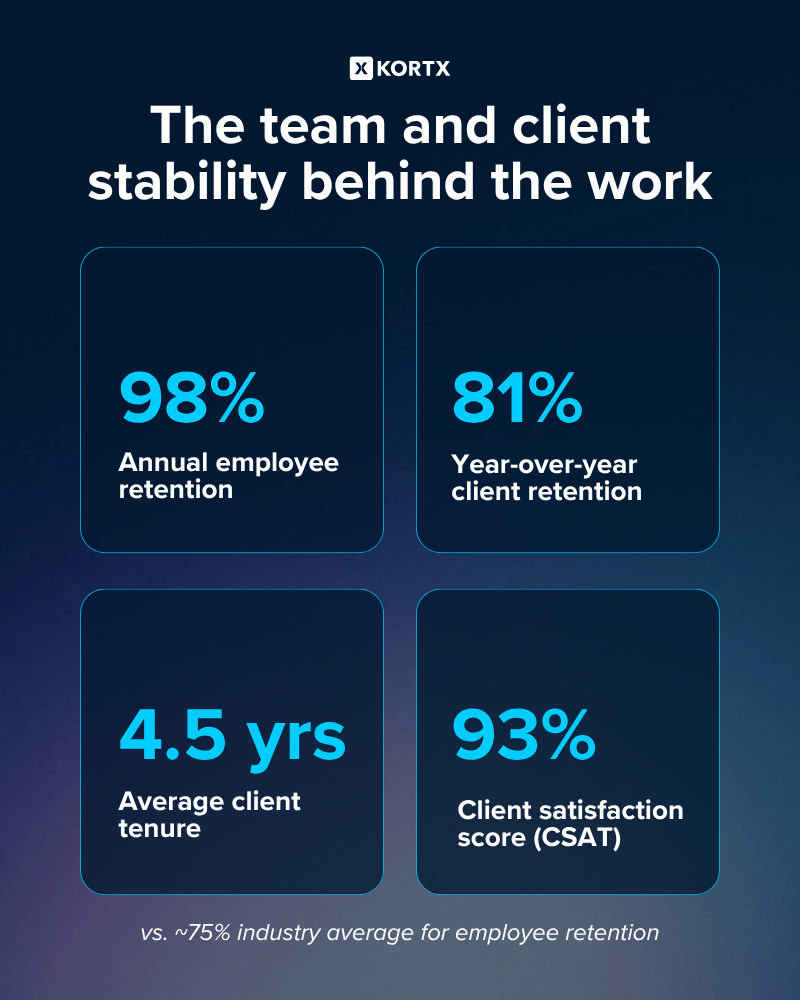
Mid-market clients get buried under partner churn. Look for a team where the leads on your account have been there more than two years, and where the AE you met in the pitch is still around a year in. As a benchmark: our annual employee retention runs at 98% against an industry average closer to 75%, half of our team has been here five-plus years, and our entire leadership group has been in seat since 2018 or earlier. That stability shows up in the client relationships too — 81.3% year-over-year client retention, a 4.5-year average client tenure, and a 93% CSAT. The right question to ask any prospective partner isn’t “how long have you been around?” It’s “how long do your people and clients stay?”
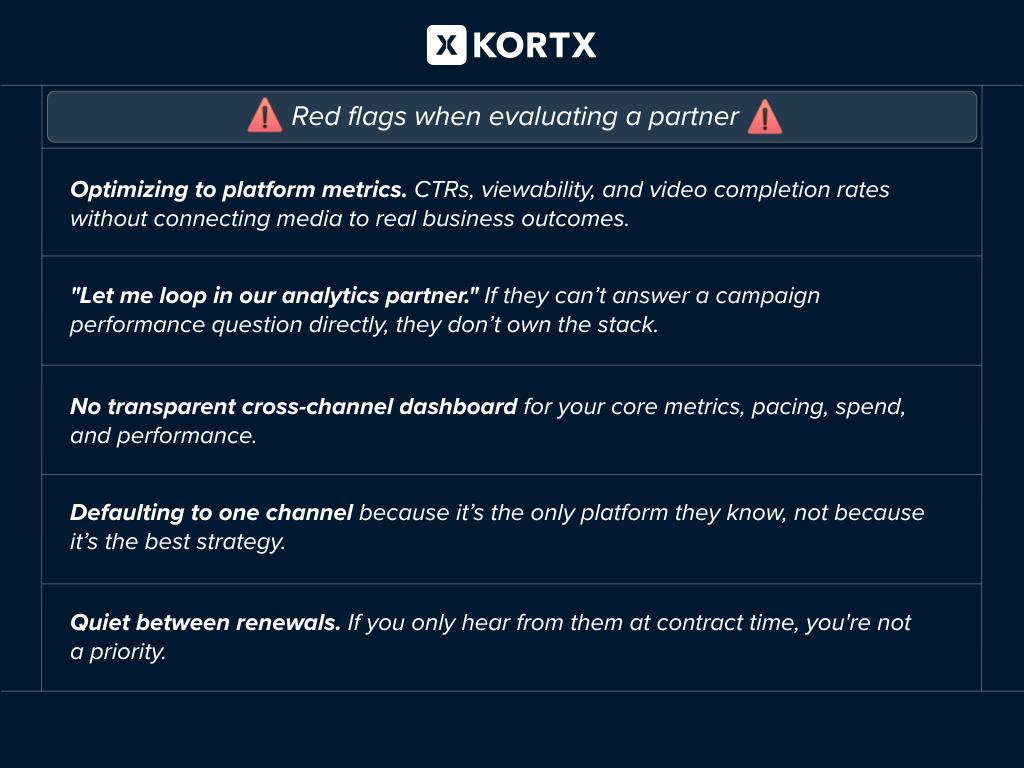
Red flags when evaluating a mid-market programmatic partner
A few patterns to walk away from:
- Partners that optimize to platform metrics – CTRs, viewability, video completion rates – but can’t connect that activity to business outcomes like leads, store visits, pipeline, or revenue.
- Partners that need to “loop in their analytics partner” to answer a basic question about how your campaign is performing. Your data team shouldn’t live at a third-party desk on a different SOW.
- Partners without a strong, transparent cross-channel dashboard for your core metrics. Daily visibility into spend, delivery, pacing, and outcomes across every channel you’re buying is the baseline.
- Partners that default to one channel because it’s the only one they’ve been trained on. Your audience doesn’t live on a single platform, and your media plan shouldn’t either.
- Partners that go quiet between renewal conversations and resurface only when budget is on the table.
- Partners that can’t explain why a tactic is in your plan. If the answer to your strategy question is a black box, you’re not buying media strategy; you’re renting a button.
What “good” looks like
Good mid-market programmatic work looks like a partner you can trust, not a pitch deck full of senior names that quietly disappears the week the contract gets signed. It’s the same A-team in week 51 who pitched you in week 1. It’s a dashboard you actually believe, a plan you can defend, and a strategist who tells you what’s not working before it becomes a problem. Fewer platforms, clearer answers, and media tied directly to the outcomes your business is measured on.
Where KORTX fits
KORTX was built for mid-market brands that need performance without unnecessary complexity. We operate the platforms directly, but more importantly, we unify campaign data into a single, actionable view, so you’re not managing five dashboards or guessing which numbers to trust. Our focus is simple: connect media to real business outcomes and give your team the clarity to act on it. We keep teams senior, workflows efficient, and reporting grounded in what actually matters. If that’s the kind of partnership you’re looking for, we should talk.
FAQ
What does “mid-market” actually mean in programmatic advertising? Most practitioners use mid-market to describe brands between $50M and $1B in annual revenue, with media budgets generally in the $500K to $25M range per year. The key marker isn’t the number, it’s that the brand is past the scrappy SMB stage but hasn’t yet built an in-house programmatic team.
Should mid-market brands use a managed service or self-serve DSP model? Most should start with a managed service model. Self-serve DSPs require at least two to three full-time specialists, plus a data engineering resource, to run competently. Managed service gets you that team without the headcount.
Is a full-service partner or a programmatic specialist better for mid-market? It depends on the rest of your stack. If you already have strong brand, creative, and search partners, a programmatic specialist will usually outperform a jack-of-all-trades partner. If you’re consolidating, a full-funnel partner with real programmatic depth is the move.
What should a mid-market programmatic budget actually look like? Expect to spend somewhere between 20% and 50% of your digital media budget on programmatic, depending on vertical. Partner fees are typically layered as a percentage of working media, with transparency on any additional tech or data costs.
Turn this evaluation into action
The hardest part of choosing a programmatic partner isn’t building the shortlist, it’s knowing the right questions to ask once you’re in the room. If you’d like a working session with our team to pressure-test your current setup against the criteria above, get in touch. No pitch deck, no hard sell, just a real conversation about whether KORTX is the right fit for where your brand is headed.