



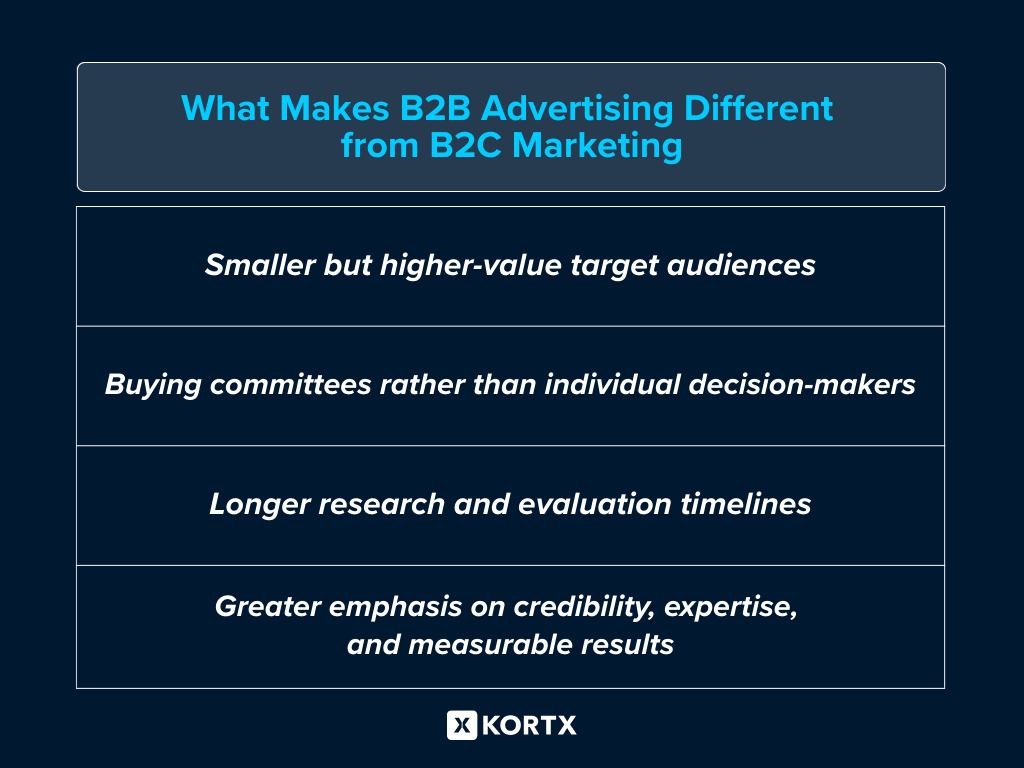
B2B advertising operates in a very different environment than consumer marketing. Instead of reaching millions of potential buyers, B2B marketers are often targeting a defined universe of high-value accounts, sometimes just a few hundred companies, each with multiple stakeholders involved in the purchasing decision.
And those decisions rarely happen after a single interaction. Buyers research, they compare vendors, they bring colleagues into the conversation, procurement and finance weigh in. Deals evolve over months, not days. For marketers, that means success isn’t just about generating leads, but reaching the right companies, influencing multiple decision-makers, and maintaining momentum throughout a long and complex buying journey.
At KORTX, we help B2B brands and agencies execute audience-first digital advertising strategies designed for this environment by combining targeting, full-funnel media activation, and analytics that connect advertising performance to real pipeline growth. This playbook outlines how modern B2B marketers approach audience targeting, funnel strategy, creative development, and measurement to drive meaningful business outcomes.
What Makes B2B Advertising Different from B2C Marketing
Understanding the B2B Buyer Journey
The B2B purchase process rarely follows a straight path. Buyers move between research, evaluation, and internal alignment across weeks or months. Effective B2B advertising supports each stage of this journey.
Stage 1: Early Research (Problem Awareness)
At the earliest stage, buyers are exploring industry challenges and potential solutions. They may not yet know which vendors—or even which product categories—are relevant.
Typical signals include:
- Searching broad industry or problem-based terms
- Engaging with analyst reports or industry publications
- Reading blogs, guides, or thought leadership content
Advertising strategy
- Sponsored thought leadership distribution
- Native advertising in industry publications
- Video and programmatic placements promoting insights
The goal is to build credibility and enter the buyer’s consideration set early.
Stage 2: Solution Evaluation
Once buyers understand their problem, they begin evaluating vendors and technologies.
At this stage, decision-makers want clarity around value, differentiation, and real-world results.
Typical signals include:
- Visiting product or solution pages
- Comparing capabilities across vendors
- Attending webinars or requesting case studies
Advertising strategy
- Retargeting campaigns with deeper content
- Feature comparisons and proof-driven messaging
- Sales-supported nurture programs
The goal is to demonstrate value and reinforce credibility.
Stage 3: Vendor Selection
During the decision phase, internal alignment becomes critical. Procurement, finance, and IT teams often enter the process.
Typical signals include:
- Demo or trial requests
- Security and compliance documentation downloads
- Visits to contact or pricing pages
Advertising strategy
- Account-based advertising targeting high-value companies
- Persona-specific messaging for different stakeholders
- Urgency-driven calls-to-action
Advertising at this stage helps remove friction and support sales conversations.
Stage 4: Customer Expansion
For B2B organizations, the relationship doesn’t end when the deal closes. Retention and expansion are essential for long-term growth.
Typical signals include:
- Product adoption increases
- Additional team members joining the platform
- Engagement with advanced features or training
Advertising strategy
- Customer lifecycle campaigns
- Cross-sell and upsell promotions
- Education and adoption-focused content
The goal is to increase lifetime value and deepen the customer relationship.
How to Build an Effective B2B Advertising Audience Strategy
In B2B marketing, the total addressable market is often small, but each opportunity carries significant value. That makes audience targeting one of the most important components of a successful B2B digital advertising strategy.
At KORTX, we use an audience-first framework to help B2B brands identify and activate high-value accounts.
CRM-Based Modeling
Customer and prospect data can be used to build lookalike audiences, re-engage dormant accounts, and exclude active opportunities already in the sales pipeline.
Firmographic Targeting
Campaigns can be refined based on company size, revenue, industry, and geographic footprint.
Intent Data Integration
Intent data from providers like ZoomInfo helps identify companies actively researching relevant solutions.
Technographic Signals
Identifying organizations using complementary technologies—or competitor platforms—creates valuable targeting opportunities.
Buying Committee Segmentation
Different stakeholders evaluate solutions differently. Messaging should reflect the priorities of technical leaders, financial decision-makers, and operational teams. In a limited market, precision matters more than reach.
B2B Advertising Funnel Strategy for Long Sales Cycles
B2B sales cycles commonly span six to twelve months, or even longer. Advertising programs must support buyers throughout this journey while maintaining consistent brand presence.
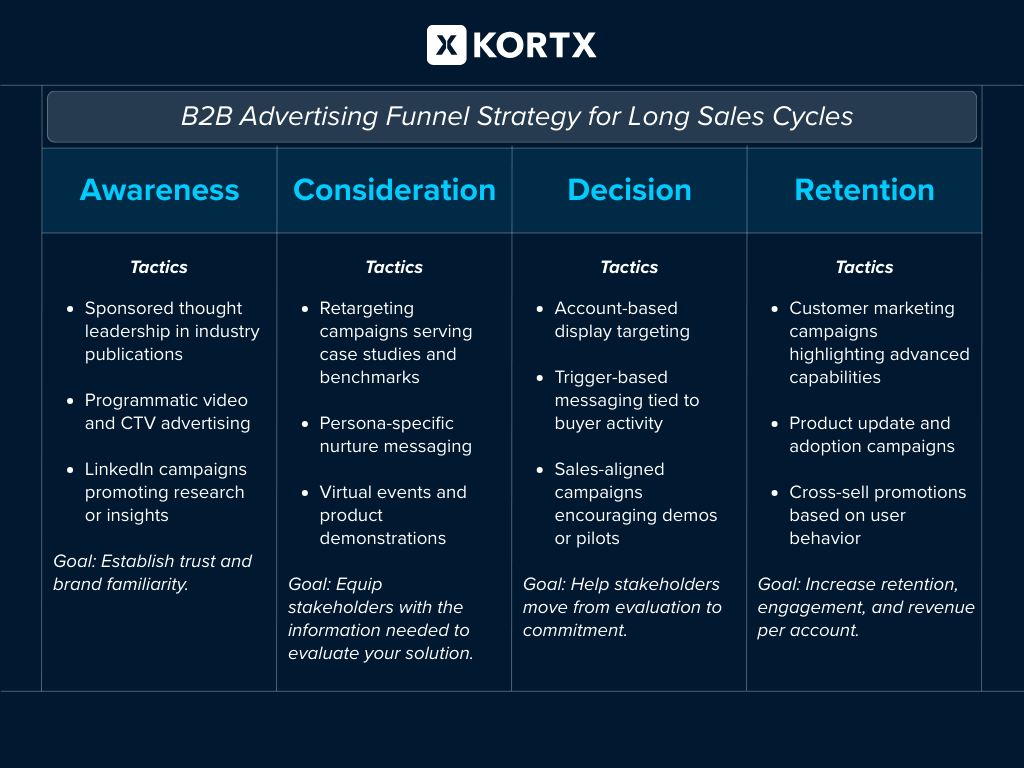
Awareness: Build Credibility Early
Tactics
- Sponsored thought leadership in industry publications
- Programmatic video and CTV advertising
- LinkedIn campaigns promoting research or insights
Goal: Establish trust and brand familiarity.
Consideration: Reinforce Value
Tactics
- Retargeting campaigns serving case studies and benchmarks
- Persona-specific nurture messaging
- Virtual events and product demonstrations
Goal: Equip stakeholders with the information needed to evaluate your solution.
Decision: Support Conversion
Tactics
- Account-based display targeting
- Trigger-based messaging tied to buyer activity
- Sales-aligned campaigns encouraging demos or pilots
Goal: Help stakeholders move from evaluation to commitment.
Expansion: Grow Lifetime Value
Tactics
- Customer marketing campaigns highlighting advanced capabilities
- Product update and adoption campaigns
- Cross-sell promotions based on user behavior
Goal: Increase retention, engagement, and revenue per account.
B2B Creative Strategy: Messaging That Resonates with Decision-Makers
B2B buyers are pragmatic. They want clarity, proof, and relevance, not marketing buzzwords. The most effective B2B advertising focuses on the business problem being solved, not just product features.

Messaging Principles for B2B Advertising
- Lead with the challenge. Address the operational or strategic pain point facing the buyer.
- Provide industry context. Demonstrate credibility within the specific vertical.
- Highlight measurable outcomes. Data points, benchmarks, and case studies build trust.
- Use meaningful calls-to-action. Specific offers—frameworks, benchmarks, or assessment tools—perform better than generic downloads.
Formats That Perform Well in B2B Advertising
- Interactive tools such as ROI calculators and maturity assessments
- LinkedIn carousel ads for multi-step storytelling
- Account-based landing pages tailored by industry or persona
- Short-form video featuring product walkthroughs or customer testimonials
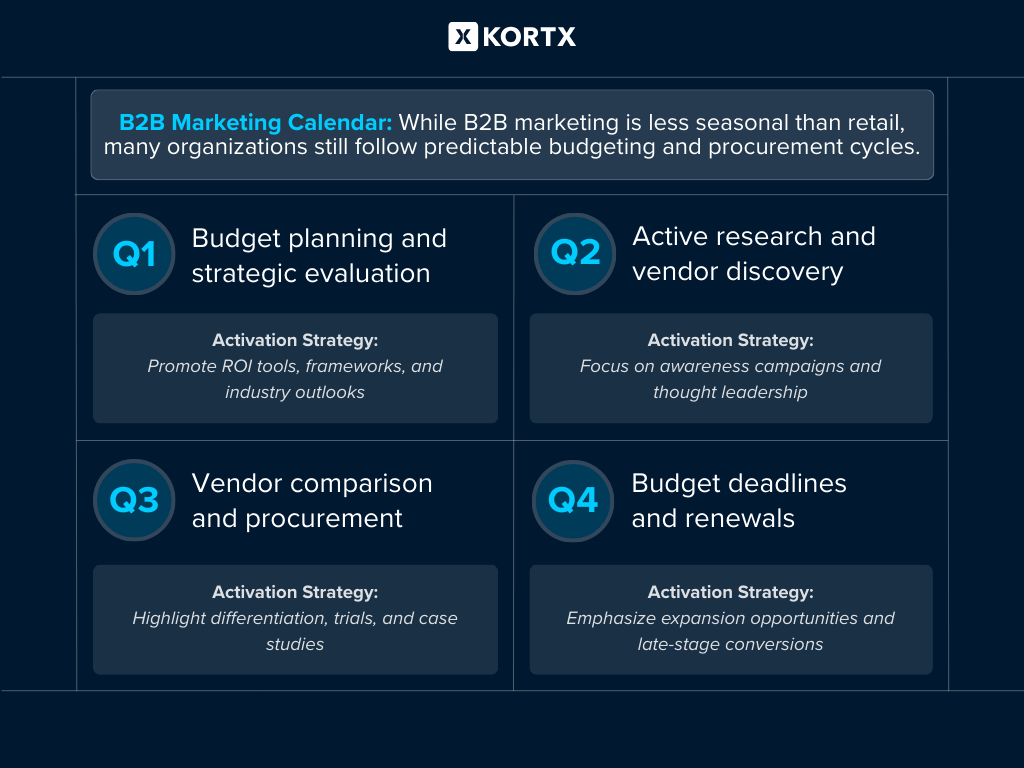
B2B Marketing Calendar: Key Planning Moments
While B2B marketing is less seasonal than retail, many organizations still follow predictable budgeting and procurement cycles.
Understanding these rhythms helps advertisers align campaigns with key decision windows.
Industry conferences, trade shows, and analyst reports can also create valuable engagement opportunities.
How to Measure B2B Advertising Performance
Because B2B deals can take months to close, traditional last-click attribution rarely tells the full story. Modern B2B advertising strategies require analytics frameworks that connect marketing activity to account engagement and pipeline movement.
Key Metrics We Track at KORTX
- Form fills, demo requests, and content engagement
- Account-level matchbacks using CRM and IP intelligence
- Account engagement scoring across media and content
- Lead-to-opportunity conversion rates
- Influenced pipeline and revenue contribution
These insights help marketers understand not just which campaigns generate leads, but which efforts actually accelerate deals.
How KORTX Helps B2B Brands Accelerate Pipeline
B2B advertising programs require deep audience intelligence, cross-channel activation, and measurement frameworks that connect media to pipeline.
KORTX partners with B2B brands and agencies to deliver:
- Audience-first targeting strategies using CRM, intent, and firmographic data
- Cross-channel digital advertising across programmatic and social such as LinkedIn
- Creative strategies designed for multi-stakeholder buying journeys
- Advanced analytics connecting marketing investment to revenue outcomes
The result is advertising that doesn’t just generate leads, it builds buying momentum across the accounts that matter most.
Final Takeaway: Precision Wins in B2B Advertising
B2B marketing isn’t simply a slower version of consumer advertising. It’s a fundamentally different challenge. Success depends on reaching the right companies, engaging multiple stakeholders, and maintaining momentum across a complex buying journey. With the right audience intelligence, advertising strategy, and analytics framework, B2B marketers can move beyond lead generation and create real pipeline acceleration.
Ready to accelerate your B2B pipeline with audience-first digital advertising?
About the author. Jess Ostrom is a digital marketing leader with more than 13 years of experience across a wide range of industries. She specializes in transforming complex data into clear, actionable insights and currently oversees our Account Management team. Jess is a strong advocate for integrated marketing strategies, emphasizing that true success comes when every channel works together to tell a cohesive story.