



The short version: US shoppers are on track to spend a record $275.1 billion online this holiday season, and a growing share of that spending starts with an AI tool, not a search bar. Brands and agencies that coordinate CTV, programmatic, paid social, and paid search now are positioned to capture that extra $17.3 billion, not just compete for the share they got last year.
Holiday shoppers are about to spend $275 billion online
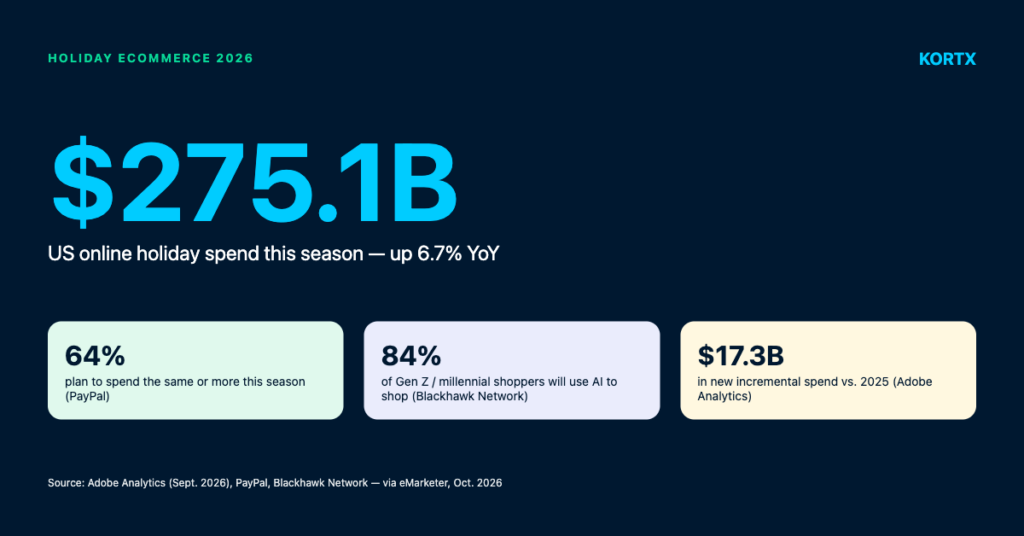
US shoppers will spend $275.1 billion online this holiday season, up 6.7% year over year, according to a September 2026 Adobe Analytics study. That’s $17.3 billion in new spend up for grabs, and it’s showing up earlier, across more channels, and with more AI assistance than any holiday season before it.
For brands and the agencies buying media on their behalf, that’s not just a cheerful stat for the year-end recap. It’s a signal of where the next six weeks of budget should go.
Three things driving the growth
Shoppers aren’t pulling back, they’re just getting pickier about how and when they spend. Three patterns are worth building a plan around:
- They’re still spending, just on their own terms. Most shoppers plan to match or beat last year’s holiday spend (see the table above), so total category demand is there to win, not just defend.
- AI is the new shopping assistant. For younger shoppers especially, AI tools are now a default stop between “I want a gift” and “I bought a gift”, comparing prices, surfacing deals, and shortlisting products before a shopper ever reaches a brand’s site or a retailer’s search results.
- Deal-waiters are driving the calendar. Cyber Five keeps gaining share of holiday spend as more shoppers hold out for deeper discounts, which pushes the real decision window later into the season than a lot of media plans assume.
Put together: more total demand, a growing share of it filtered through AI discovery tools, and a buying public that’s patient enough to wait you out on price.
What it means for your media plan
A few concrete moves for the next six weeks:
CTV and programmatic: build for AI-assisted discovery
If a third of shoppers are letting AI tools surface products and compare prices for them, creative needs to read clearly outside a search results page. Strong product shots, clear pricing and offers, and messaging that still lands when a shopper is scanning, not reading. CTV’s high-impact placements and programmatic’s targeting precision both earn their keep here.
Paid social: meet shoppers where they’re already comparing
Social feeds are where a lot of gift research happens before a shopper ever searches. Keep always-on social spend live through the full season rather than front-loading it into early November, so the brand is already familiar by the time a shopper is ready to buy.
Paid search: don’t cede the bottom of the funnel
As AI shopping tools absorb more of the early “what should I buy” research, paid search needs to work harder at the moment a shopper has already decided and is looking to act. Sharpen bids and copy around high-intent, close-to-purchase terms.
Timing and targeting: defend the deal-waiters
Don’t spend the whole budget early. Use the PayPal deal-waiting data to plan when to go heavier on promotion-driven creative, and use DMA- or audience-level targeting so that spend lands with the shoppers most likely to convert, not just the broadest possible reach.
“Brands and agencies that coordinate CTV, programmatic, paid social, and paid search now are positioned to capture that extra $17.3 billion, not just compete for the share they got last year.”
Frequently asked questions
How much will US shoppers spend online this holiday season?
US shoppers are projected to spend $275.1 billion online during the 2026 holiday season, up 6.7% from last year, according to a September 2026 Adobe Analytics study cited by eMarketer.
Why are AI shopping assistants a bigger deal this holiday season?
Because a large share of shoppers now use them before they ever reach a brand or retailer. 84% of Gen Z and millennial shoppers say they’ll use AI tools to find deals, compare prices, and get gift ideas this season, compared with 51% of Gen X and boomers, per Blackhawk Network.
When should brands spend their holiday advertising budget?
Not all at once. With deal-waiting shoppers pushing more purchases into Cyber Five and beyond, brands that keep media live and flexible through late November and into December are better positioned than those that front-load spend in early November.
Which advertising channels matter most for holiday 2026?
CTV and programmatic for high-impact, AI-discoverable creative; paid social for always-on brand familiarity before shoppers start comparing; and paid search for capturing high-intent shoppers once they’ve decided to buy.
Don’t run this holiday season alone
A record holiday season rewards brands that can move fast across search, social, programmatic, and CTV at the same time, and that’s exactly where a managed-service partner earns its keep. KORTX’s team runs paid search, paid social, programmatic, and CTV campaigns for brands and agencies directly, backed by the checks and balances of an operating system built over a decade and $300M+ in managed media.
- Paid search — capture high-intent, bottom-of-funnel holiday demand
- Paid social — always-on presence through the full deal-waiting window
- Programmatic — precision targeting by DMA, state, or national audience
- CTV — high-impact, brand-focused placements built for discovery
If you’re weighing where to put your last-mile holiday dollars, let’s talk before Black Friday.
Sources
- Holiday ecommerce is headed for another record season, EMARKETER, Oct. 22, 2026 — primary source, citing Adobe Analytics, September 2026
- US shoppers use BNPL, rewards to keep up holiday spirit, EMARKETER / PayPal
- Holiday shoppers turn to AI, BNPL, rewards as household budgets tighten, EMARKETER / Blackhawk Network