


TL;DR: Government and non-profit marketing works when it treats every dollar as a public one: media has to reach the right constituent, at the right eligibility window, with a message that earns trust and drives a specific action, not just an impression. Brands and agencies that combine first-party constituent data, full-funnel strategy built around public rhythms, and creative that proves mission impact consistently outperform broad-reach, one-size-fits-all outreach. This playbook covers how to build that program from the ground up.
For government agencies and non-profits, marketing isn’t just about acquisition. It’s about engagement, trust, service, and impact. Whether you’re driving public awareness, managing programs, raising funds, or engaging constituents, your marketing has to be cost-efficient, compliant, and outcome-driven. You don’t just want clicks; you want actions, change, and real impact.
At KORTX, we help government and non-profit organizations craft audience-first, full-funnel campaigns that align media with mission, behavior, and public value.
What Makes Government & Non-Profit Marketing Different
Government and non-profit marketing runs on a different incentive structure than commercial categories, and that shapes everything from targeting to measurement.
- Mission, not margin, is the metric. Success is measured in participation, compliance, awareness, or dollars raised for a cause, not revenue or share of wallet, which changes what “performance” even means.
- The addressable market is defined by eligibility, not demand. TAM isn’t “everyone who might want this”, it’s bounded by geography, citizenship, income level, zip code, or program qualification, so the real opportunity is often far smaller than the general population.
- Budgets move on fiscal years, grants, and legislation, not demand curves. Spend windows open and close around appropriations, grant cycles, and legislative sessions, often with use-it-or-lose-it constraints.
- Trust and transparency are the actual product. A citizen or donor is trusting an institution with their time, their money, or their personal information, so credibility carries as much weight as the offer itself.
- Compliance and procurement shape what’s even possible. Messaging, data use, and media buys often have to clear legal, accessibility, and procurement requirements that a typical commercial campaign never touches.
- Decisions are rarely instant. Enrolling in a program, applying for a grant, or committing to a recurring donation usually involves more deliberation — and more stakeholders — than a typical consumer purchase.
Understanding the Constituent Journey
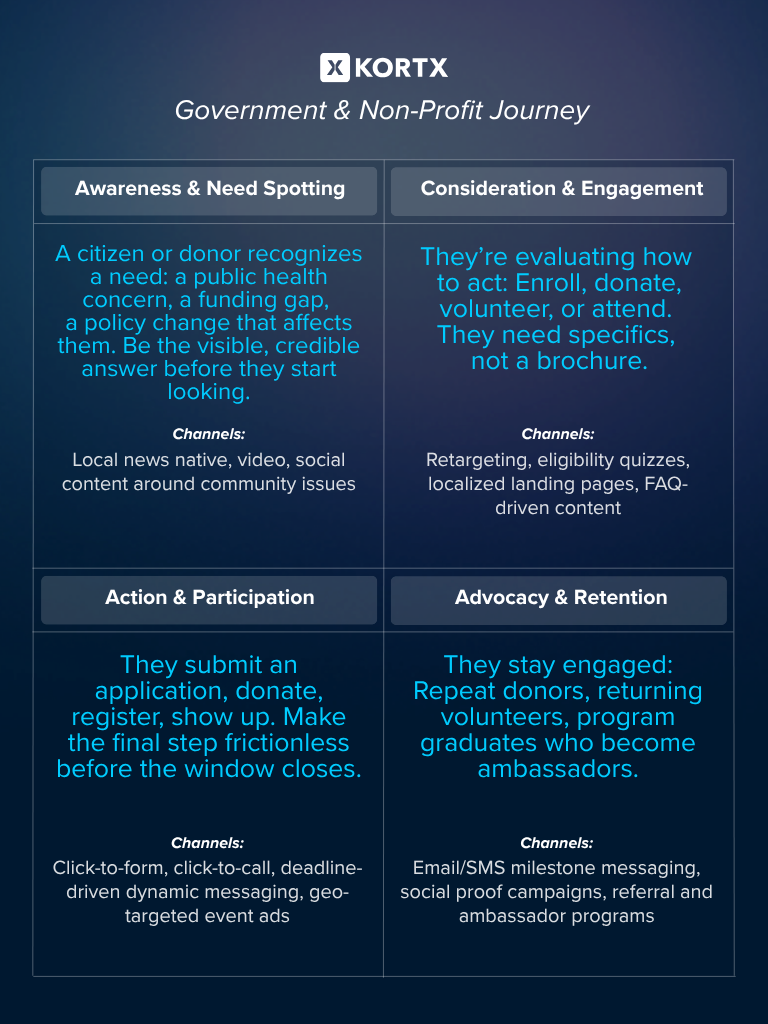
Citizens, donors, and program participants aren’t one audience moving through one journey — enrollment, advocacy, and giving all move at different speeds. Still, four stages show up across nearly every government and non-profit program.
Stage 1: Awareness & Need Spotting
A citizen or donor recognizes a need: a public health concern, a community gap, a funding shortfall, a policy change that affects them.
Typical signals include:
- Broad information search — “how do I apply for [benefit]” or “best food banks near me”
- Social discussion and news exposure around a cause, policy, or local issue
- Engagement with public service content and awareness campaigns
Advertising strategy: Lead with education and relevance — show up where the need is being defined, in community and local news media, not just where your program is named.
Goal: Position your agency or organization as the credible, visible answer before the person starts actively looking for help.
Stage 2: Consideration & Engagement
They’re evaluating how to act — learn more, donate, volunteer, enroll, attend an event.
Typical signals include:
- Program and eligibility page visits, content downloads, event registrations
- Newsletter sign-ups, comparing providers or causes
- FAQ and application-requirement page views
Advertising strategy: Retarget with specificity — eligibility details, clear next steps, and localized landing pages that answer the exact question this visitor has.
Goal: Remove friction and uncertainty so the person knows exactly what to do next.
Stage 3: Action & Participation
They commit — sign up for a service, submit an application, donate, share, attend.
Typical signals include:
- Conversion events: completed forms, booked appointments, submitted applications
- Donation transactions, event RSVPs, volunteer sign-ups
Advertising strategy: Make the final step frictionless — dynamic deadline messaging, click-to-form and click-to-call paths, and urgency tied to real program windows (“Enroll by Dec 1”).
Goal: Convert intent into a completed action before a deadline or interest window closes.
Stage 4: Advocacy & Retention
They stay engaged over time — repeat donors, returning volunteers, program graduates who become ambassadors.
Typical signals include:
- Repeat donations or volunteer shifts, ongoing program participation
- Referrals, shared content, testimonials
Advertising strategy: Keep showing up with recognition and reward — milestone messaging, social proof (“Join 10,000 volunteers”), and referral or ambassador programs.
Goal: Turn a single action into a lasting relationship with the mission.
How to Build a Government & Non-Profit Audience Strategy
For government and non-profit organizations, TAM isn’t simply “everyone.” It’s defined by geography, program eligibility, demographic fit, and behavioral readiness, and the brands that perform best treat that boundary as an advantage, not a limitation.
What makes this audience work different:
- Defined by region, citizenship, demographic, and eligibility — income level, veteran status, zip code, age, or program qualification
- Multi-channel engagement — online, offline, and community outreach all have to work together, since not every constituent is reachable (or most reachable) digitally
- Metrics tied to behavior, not purchases — volunteer hours, sign-ups, compliance, and program completion matter more than transaction value
Our targeting method:
- First-party lists of constituents, donors, and volunteers, used to build engagement and lookalike models
- Geofencing and location-based targeting around town halls, community centers, and event zones
- Behavioral and intent data — people actively searching “voter registration,” “community volunteering,” or program-specific terms
- Exclusion logic to cut segments that are ineligible, out of footprint, or already enrolled
- KORTX Intelligence, built on more than a decade of campaign performance data across 10,000+ campaigns, 1 billion+ user records, and 15,000+ audience attributes, helps move from an audience hypothesis to a confident, addressable audience
By refining the audience this way, resources concentrate on the people where action is likely, instead of spreading thin across an entire population.
Government & Non-Profit Advertising Funnel Strategy
Top-of-Funnel: Awareness & Education
- Video campaigns highlighting mission outcomes, public value, and community stories
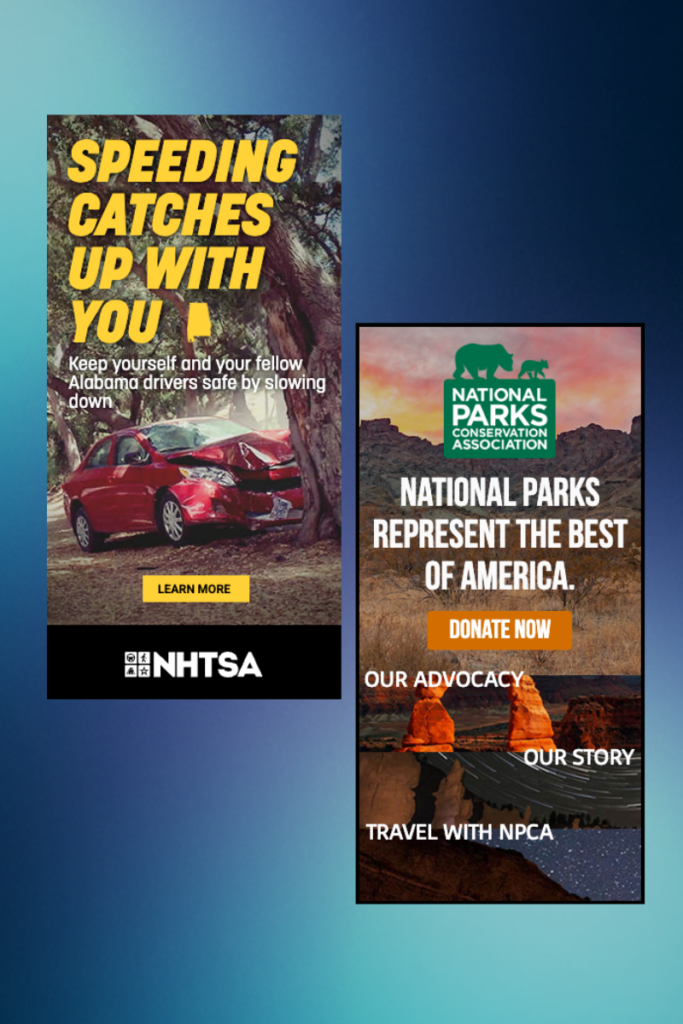
- Native ads in local news and community media
- Social content promoting upcoming events or public programs
Goal: Build visibility and trust before anyone needs to act.
Mid-Funnel: Engagement & Conversion Prep
- Retargeting ads to citizens or donors who visited the site but didn’t act
- Interactive tools like eligibility quizzes (“Which public program fits you?”)
- Localized landing pages by region or program
Goal: Move people from interested to ready, with the specific information that removes doubt.
Bottom-Funnel: Action & Follow-Through
- Click-to-form and click-to-call ads for registration or donation
- Geo-targeted ads for event locations or appointment slots
- Dynamic messaging tied to eligibility or urgency (“Enroll by Dec 1”)
Goal: Convert intent into a completed form, donation, or enrollment.
Retention & Advocacy
- Email and SMS campaigns to volunteers and repeat donors
- Social proof campaigns — “Join 10,000 volunteers” or “You helped raise $X”
- Referral campaigns and community ambassador programs
Goal: Extend a single action into ongoing participation and advocacy.
Government & Non-Profit Creative Strategy
Success in this space depends less on a hard sell and more on clear value, relevance, and credible storytelling.
Key creative principles:
- Speak to the mission and the outcome — “Help feed 1,000 families this season,” not a generic program description
- Use real people and real, local context — authenticity carries more weight here than polish
- Make the call to action clear and specific — “Apply by Nov 15,” “Donate now,” “Register for the community forum”
- Be transparent about eligibility, timelines, and impact — trust is the product, and vague claims undermine it
Formats that perform:
- Short-form video for social — personal stories, event highlights, program outcomes
- Interactive creative — eligibility calculators, event maps
- Dynamic display with region-specific messaging
- Mobile-first design, given how much of this audience engages primarily on a phone
The Government & Non-Profit Marketing Calendar
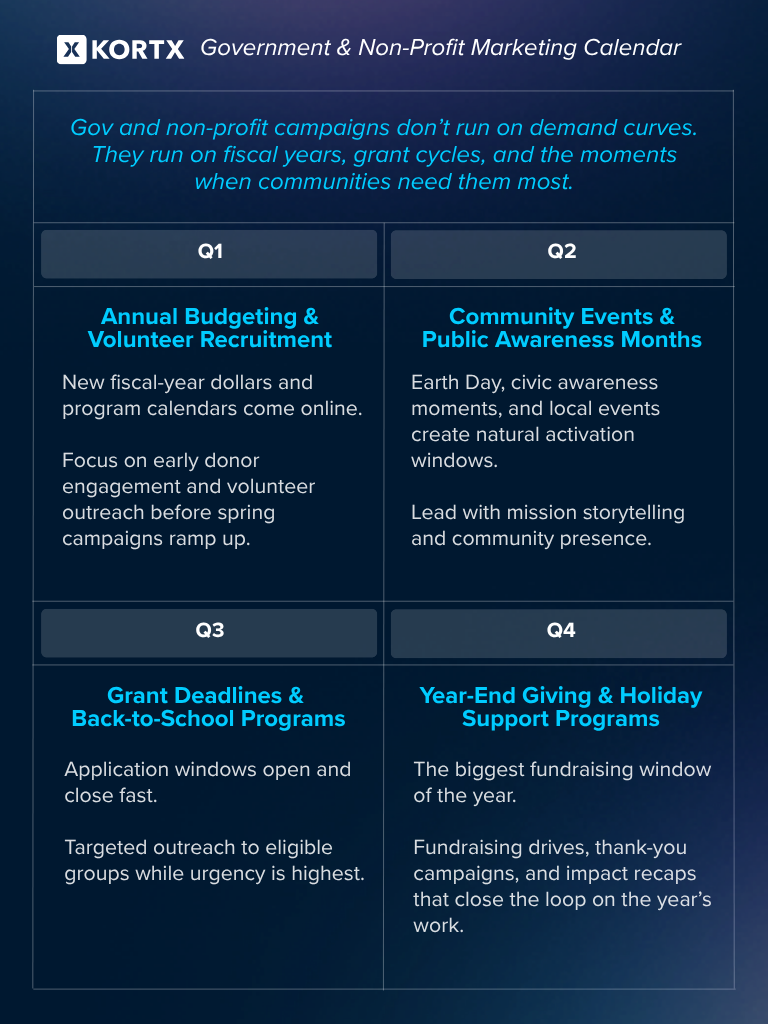
Timing in this space ties to budgets, legislative cycles, community events, and annual giving, not demand curves.
- Q1: Annual budgeting and volunteer recruitment. Focus on outreach campaigns and early donor engagement as new fiscal-year dollars and program calendars come online.
- Q2: Community events and public awareness months. Activations and event-based marketing around moments like Earth Day and local civic calendars.
- Q3: Grant application deadlines and back-to-school programs. Targeted outreach to eligible groups as application windows open and close.
- Q4: Year-end giving and holiday support programs. Fundraising drives and thank-you campaigns around the biggest giving window of the year.
Layer in micro-moments too: legislative sessions, disaster response windows, and national awareness days all create short bursts of relevance that are worth activating around quickly, even outside the planned calendar.
How to Measure Government & Non-Profit Advertising Performance
Measuring results here means tracking behavior change, not just clicks.
Metrics to monitor:
- Form completions — registrations, applications, sign-ups
- Volunteer hours and event attendance
- Donation amounts and donor retention
- Continued engagement — repeat usage, repeat giving
- Cost per action and cost per constituent reached, by channel and segment
By linking digital touchpoints to these outcomes, you can demonstrate value to stakeholders and inform the next cycle’s strategy.
How KORTX Helps Government & Non-Profit Brands and Agencies
- Define and activate the right audience — reducing wasted reach by targeting on eligibility, geography, and behavior instead of broad demographics
- Build full-funnel programs aligned to mission and public rhythms, from awareness through advocacy
- Create creative that builds credibility, trust, and urgency, grounded in real stories and real impact
- Measure campaigns by impact, not just impressions or clicks, with reporting that connects media to outcomes stakeholders actually care about
Final Takeaway: Trust Beats Reach in Government & Non-Profit
Mission-driven organizations need marketing that drives meaningful action, not just visibility. Broadcasting broadly without targeting precision wastes budget and loses potential impact that a tighter, trust-first program would have captured.
At KORTX, we help government and non-profit brands define their audience, activate full-funnel campaigns aligned with mission and behavior, and measure what actually matters: participation, trust, and impact.
Ready to turn your mission into measurable action? Let’s talk strategy →
Frequently Asked Questions
What makes government and non-profit marketing different from other verticals? The addressable market isn’t the general public — it’s bounded by eligibility, geography, and program qualification — and the real product being sold is trust, not a feature or a price.
How do you target government and non-profit audiences effectively? By layering first-party constituent, donor, and volunteer data with geofencing, eligibility segmentation, and behavioral intent signals, then excluding anyone who’s ineligible, out of footprint, or already enrolled.
What’s the biggest mistake government and non-profit organizations make in advertising? Treating the audience as “everyone” instead of defining it by eligibility and readiness, which spreads limited budget across people who were never going to act.
How important is timing in government and non-profit campaigns? Critical. Spend windows tie to fiscal years, grant cycles, and legislative sessions, so campaigns timed to those windows consistently outperform always-on, generic outreach.
How do you measure government and non-profit advertising performance? Through behavior change rather than clicks — form completions, volunteer hours, donation amounts, donor retention, and cost per constituent reached.
How often should government and non-profit brands refresh their creative? On a cycle tied to program and funding changes — new eligibility rules, a new grant cycle, or a shift in public need can make creative feel out of date quickly.