



TL;DR: Tech and telecom marketing works when it meets buyers at the exact moment infrastructure, budget, and readiness align, whether that’s an enterprise IT team ready to migrate or a consumer whose contract just came up for renewal. Brands that combine first-party intent data, full-funnel strategy, and creative built for both technical and consumer buyers consistently outperform those relying on broad reach or one-size-fits-all messaging. This playbook covers how to build that program from the ground up.
Tech and telecom marketing works when it meets buyers at the exact moment infrastructure, budget, and readiness align, whether that’s an enterprise IT team green-lighting a cloud migration or a consumer whose two-year contract just came up for renewal.
That’s a hard moment to catch. Between 5G and edge network rollouts, SaaS-platform shifts, AI-driven products, and IoT proliferation, the ground is always moving. Buyers range from enterprise CIOs weighing a multi-year platform bet to consumers deciding whether to switch carriers for a better bundle. You’re not just competing for attention but for relevance, proof, and future-proof differentiation.
Winning here takes an audience-first, full-funnel strategy that can flex between brand-building reach and hyper-precise, technical performance marketing, often in the same campaign.
What Makes Tech & Telecom Marketing Different
- Two buyers, one brand. The same telecom or SaaS company may be selling to an enterprise IT department and a direct-to-consumer household in the same quarter, each on a completely different sales cycle.
- Innovation moves faster than buying cycles. 5G, AI features, and new device tiers roll out continuously, and buyer readiness shifts with them. Timing matters as much as targeting.
- Decision cycles range from instant to endless. A consumer can switch carriers on a whim; an enterprise network overhaul can take 12-18 months and a dozen stakeholders.
- Trust and reliability are the real product. Uptime, service quality, and data security carry as much weight in the decision as price or features.
- Regulation and infrastructure set real limits. Spectrum rules, service availability, and geographic buildout constrain who you can even talk to, let alone convert.
Understanding the Buyer & Decision Journey
Tech and telecom buyers aren’t just one journey. Instead, they’re several running at different speeds. An enterprise IT decision-maker, a network operator, and a consumer replacing a phone all move through distinct paths, but they follow the same four stages.
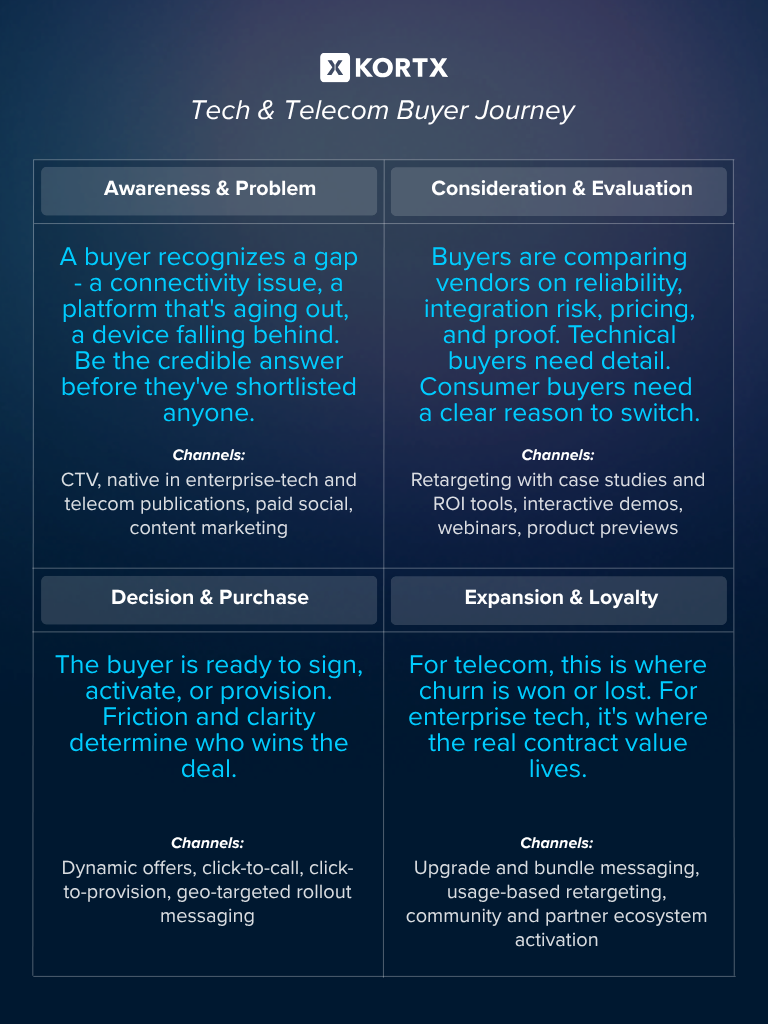
Stage 1: Awareness & Problem Definition
A buyer recognizes a challenge or opportunity: a connectivity gap, a SaaS migration, an IoT rollout, a device that’s falling behind.
Typical signals include:
- Searches like “5G fixed wireless access benefits” or “best cloud-native telecom OSS”
- Engagement with whitepapers, webinars, and analyst reports
- Browsing vendor comparisons and reviews
Advertising strategy: Lead with category education and proof points — show up where buyers are defining the problem, not just naming your product.
Goal: Position your brand as the credible answer before the buyer has shortlisted anyone.
Stage 2: Consideration & Evaluation
Buyers compare vendors, pricing, integration risk, and reliability.
Typical signals include:
- Product page visits, demo requests, technical briefs downloaded
- Case study engagement, rep conversations, trade show attendance
- For telecom: comparing network upgrades, bundles, 5G/IoT offerings
Advertising strategy: Retarget with proof — case studies, ROI tools, and technical detail that answers the specific objection this buyer has.
Goal: Remove friction and become the safe, well-understood choice.
Stage 3: Decision & Purchase
The buyer selects a vendor, negotiates, signs, or activates service.
Typical signals include:
- Quote requests, pilot program sign-ups, contract execution, CPE orders
- For SaaS: free trial to paid subscription conversion
Advertising strategy: Make the last step frictionless — dynamic offers, clear next actions, and sales support aligned to the media.
Goal: Convert intent into a signed deal or an activated account.
Stage 4: Post-Purchase, Expansion & Loyalty
Retention, upsell, cross-sell, and referral. For telecom, this is where churn is won or lost.
Typical signals include:
- Usage growth, feature adoption, upgrade conversations, renewal behavior
- Advocacy, case studies, ecosystem partner sign-ups
Advertising strategy: Keep showing up after the sale with relevant upgrade and bundle messaging, not just acquisition creative.
Goal: Maximize lifetime value and turn customers into referral sources.
How to Build a Tech & Telecom Audience Strategy
Your total addressable market can look enormous, especially in consumer telecom. But the audience that will actually buy now or soon is far smaller, and it shifts fast as new tech reaches the market.
What makes tech and telecom targeting distinct:
- Role-based enterprise targeting. CIOs, CTOs, and VPs of Engineering, segmented by company size, industry, and tech-stack maturity.
- Split consumer vs. business segments. Connectivity tiers, service plans, and geographic or regulatory constraints all shape who’s addressable.
- Fast-shifting readiness. Buyer readiness moves with product cycles, so timing your targeting matters as much as who you target.
- Long, multi-stakeholder cycles. Enterprise deals move through pilot-to-scale journeys with several decision-makers in the room.
How we make targeting surgical instead of broad:
- Model lookalikes and high-propensity segments from first-party data — current customers, pipeline, and usage behavior.
- Layer firmographic (company size, industry, tech stack), technographic (existing systems), and behavioral intent (search, content consumption) filters.
- For telecom, layer in device upgrade cycles, plan churn signals, and household or regional behavior.
- Use exclusion logic to cut segments that are unready, unqualified, or outside your service footprint.
- Geo-fence infrastructure locations and tech hubs, and place ads contextually in tech-business, telecom, and IoT media.
- Align targeting to product lifecycle: early adopters for new tech like 5G or IoT, broader market once an offering matures.
The goal isn’t reach. It’s relevance.
Tech & Telecom Advertising Funnel Strategy
Tech and telecom funnels have to do two jobs at once: high-touch enterprise sales and high-volume consumer activation. Your media mix and creative need to support brand growth and hard performance in the same plan.
Top-of-Funnel: Awareness & Positioning
- CTV and video that show innovation, connectivity, and service differentiation
- Native display and content in enterprise-tech or telecom-business publications
- Paid social for younger tech consumers and SMB segments
Goal: Position your brand as a leader and build reach with the right audience.
Mid-Funnel: Engage & Educate
- Retargeting based on content engagement — whitepapers viewed, demos watched
- Interactive tools: ROI calculators for SaaS, connectivity speed tests for telecom
- Webinars, virtual events, and product previews
Goal: Deepen intent and equip buyers with the information that removes friction.
Bottom-of-Funnel: Conversion & Activation
- Dynamic ads with tailored offers (“You qualify for a pilot,” “Switch now and get a premium bundle”)
- Click-to-call or click-to-provision for service activation
- Geo-targeted regional offers tied to infrastructure rollout
Goal: Drive sign-ups, contracts, and activations.
Post-Purchase: Upsell, Loyalty & Advocacy
- Customer-success-driven messaging: “Upgrade to multi-cloud,” “Bundle your home with IoT and broadband”
- Retargeting frequent users with premium plan, accessory, and device-upgrade offers
- Community building through user groups, forums, and partner ecosystems
Goal: Maximize lifetime value, reduce churn, and generate referrals.
Across every stage, execution runs cross-channel: social, display, CTV, and streaming audio for consumer broadband and mobile; LinkedIn, trade-publication native, and webinar sponsorships for enterprise tech; retail promotions and device-manufacturer co-promotions for telecom. Real-time triggers keep offers relevant — usage-based upgrade prompts, region-specific rollout messaging, and event-based creative tied to a device launch or new service tier.
Tech & Telecom Creative Strategy: Where Technical Meets Human
Great creative here bridges technical credibility with human relevance. Too complex and you lose attention. Too simple and you lose trust.
Key principles:
- Lead with outcome, not spec sheet — “10x connectivity speed,” “seamless hybrid-cloud management,” “switch with zero downtime”
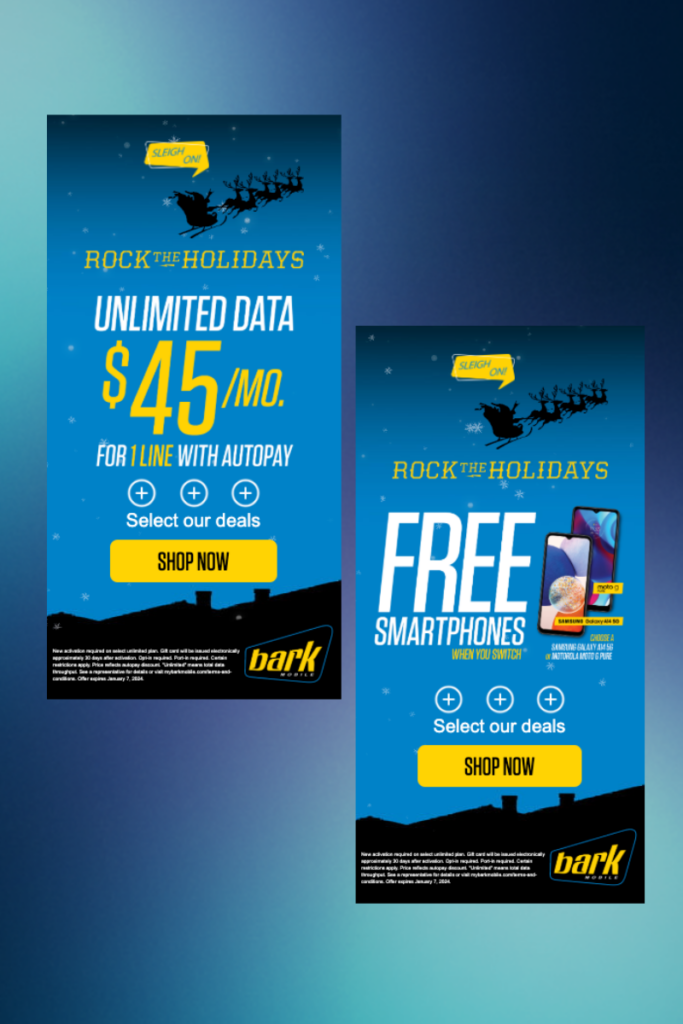
- Use real visuals: real users, real environments — smart cities, enterprise operations, connected homes
- Be transparent about limitations, pricing, and contract terms, especially in telecom where regulatory scrutiny is real
- Match the CTA to the buyer’s stage — “Schedule a demo,” “Start your trial,” “Upgrade now”
Formats that perform:
- Short-form video (15-30 seconds) for mobile and social — benefit, proof, next step
- Interactive display: configurators, device-vs-plan selectors, ROI tools
- Dynamic creative tailored by device type, segment, region, and service tier
- Content-rich units for enterprise: digital detailing, whitepaper ads, case-study carousels
The Tech & Telecom Marketing Calendar
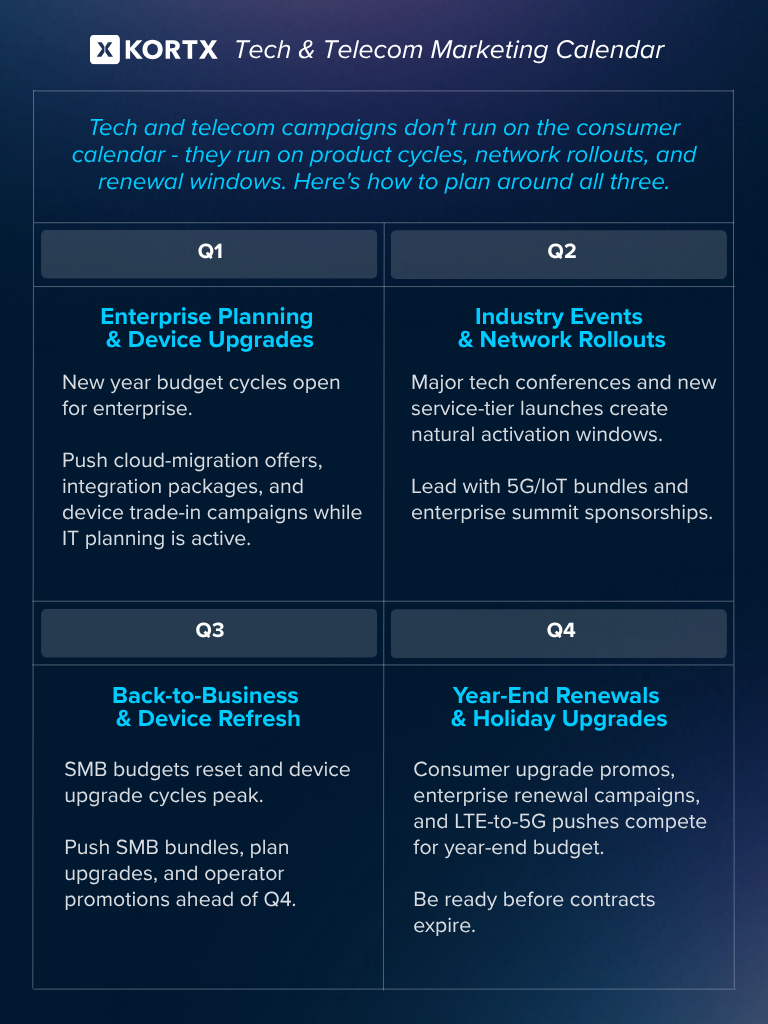
Campaigns need to track product and infrastructure cycles, device launch waves, regulatory changes, and service innovations.
How to Measure Tech & Telecom Advertising Performance
Media has to tie to business outcomes here — contract value, ARPU, churn, service upgrades — not just clicks and impressions.
The metrics we track include:
- For enterprise tech: leads to demo to contract value, pipeline velocity, cross-sell attachment
- For telecom: new subscriber acquisition, ARPU uplift, device upgrade rate, churn reduction
- Multi-channel influence: digital to store/retail activation, app install to service activation
- Lifetime value and retention: upgrade rates, service longevity, bundle adoption
- Incrementality: whether campaigns drove real growth or just cannibalized existing demand
We build dashboards that connect media spend directly to revenue growth, service upgrades, and retention — so the conversation with finance is about business impact, not impressions.
How KORTX Helps Tech & Telecom Brands and Agencies
- Define and activate the right TAM — enterprise and consumer segments modeled from first-party data and intent signals
- Build full-funnel programs aligned to buyer behavior and product or service lifecycle, from awareness through renewal
- Execute creative that earns trust — technical credibility paired with real-world proof
- Tie performance to real business outcomes — contract value, ARPU, churn, and retention, not just impressions
Final Takeaway: Precision Beats Scale in Tech & Telecom
It’s more important to be the vendor who shows up exactly when a buyer is ready than the one who shows up the most. Tech and telecom buyers are smart, options are many, and disruption is constant. Winning takes marketing that’s agile, targeted, and outcome-oriented, built to perform in both consumer and enterprise contexts at once.
If you’re ready to elevate your tech or telecom marketing engine and drive meaningful growth, let’s talk strategy.
Let’s talk tech and telecom strategy →
Frequently Asked Questions
What makes tech and telecom marketing different from other verticals?
These brands sell to two very different buyers — enterprise IT decision-makers on long evaluation cycles and consumers who can switch providers in minutes — often with the same product line.
How do you target enterprise tech buyers effectively?
By layering firmographic, technographic, and behavioral intent data to find accounts that are both a fit and in-market right now, then excluding everyone who isn’t.
What’s the biggest mistake tech and telecom brands make in advertising?
Treating a single funnel strategy as one-size-fits-all instead of running parallel programs for enterprise and consumer audiences.
How important is timing in tech and telecom campaigns?
Critical. Buyer readiness shifts fast with product and network cycles, so campaigns tied to launches, upgrades, and renewal windows consistently outperform always-on generic messaging.
How do you measure tech and telecom advertising performance?
Through pipeline velocity and contract value for enterprise tech, and subscriber acquisition, ARPU, and churn reduction for telecom — tied back to media spend, not just impressions.
How often should tech and telecom brands refresh their creative?
On a faster cycle than most B2B categories. New device launches, service tiers, and competitive claims can make creative feel dated within a quarter.