



TL;DR: Retail advertising wins when it meets shoppers in the moment, during a product search, a browsing session, a flash sale, a seasonal push. Brands and agencies that combine first-party data, full-funnel omnichannel strategy, and dynamic creative tied to real inventory and purchase behavior consistently outperform those relying on broad reach or channel-isolated thinking. This playbook covers how to build that program from the ground up.
Retail has no awareness problem. Shoppers are always searching, always browsing, always comparing. The challenge isn’t getting in front of them but being relevant at exactly the right moment in their journey, with the right message, on the right channel, whether they’re about to buy online or walk into a store.
A generic display campaign running in January performs very differently than a geo-targeted, inventory-aware creative pushing click-and-collect availability two miles from a store location. Shoppers make decisions based on convenience, price, availability, and timing, and the brands that understand those drivers, and build media around them, are the ones converting browsers into buyers.
At KORTX, we help retail brands and the agencies that serve them turn audience intelligence into measurable outcomes: online purchases, in-store visits, basket size growth, loyalty enrollment, and customers retained season over season. We’ve built campaigns across national retail chains, DTC brands, specialty retailers, and omnichannel commerce, and the patterns that drive performance are consistent.
What Makes Retail Advertising Different
Retail marketing operates under a distinct set of rules. The audience is enormous, but scale is the trap. Most retail advertisers reach too broadly and optimize for the wrong signals. The brands that win treat retail advertising as a precision exercise, connecting the right shopper to the right product at the right moment in their path to purchase.
A few realities define how effective retail advertising must be planned:
- The journey is nonlinear and cross-channel. Shoppers discover on social, research on desktop, purchase in-store, and advocate on mobile. A campaign that lives in one channel misses most of the journey. Effective retail advertising connects touchpoints across the full path — online and offline.
- Inventory and availability are creative levers. “Only 2 left near you” outperforms “Shop now” in almost every test. Real-time inventory data, store-level availability, and delivery windows aren’t operational details, they’re conversion tools when built into the creative.
- Timing drives purchase behavior. Seasonality, promotions, product launches, and competitive events create predictable windows of high purchase intent. Brands that weight media investment toward those windows — rather than running uniform always-on spend — consistently outperform.
- Online and in-store can’t be measured in isolation. A digital ad that drives a store visit is working, even if no click was recorded. Retail measurement frameworks that ignore offline attribution systematically undervalue media performance and lead to bad budget decisions.
- Loyalty is where the margin lives. First purchases are expensive. Repeat buyers, loyalty members, and high-LTV customers are the foundation of retail profitability. Media programs that treat acquisition and retention as separate workstreams leave revenue on the table.
Understanding the Retail Customer Journey
Retail shoppers don’t follow a straight path. A casual browser can convert within minutes of seeing the right offer. A loyal customer can lapse after a single poor experience. Effective campaigns meet shoppers wherever they are in that journey and move them forward.
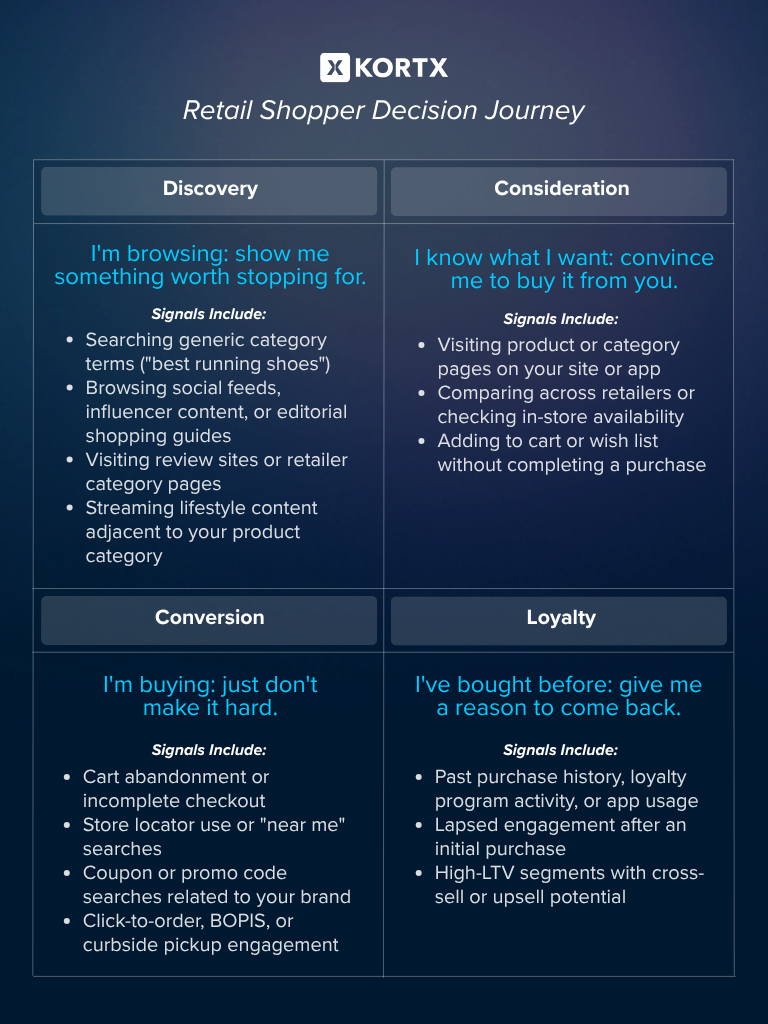
Stage 1: Discovery — Awareness and Inspiration
These are shoppers who are in-market for a category but haven’t engaged with your brand directly. They’re searching, scrolling, and absorbing, open to being influenced before they’ve formed a preference.
Typical signals include:
- Searching generic category terms (“best running shoes 2026,” “eco-friendly kitchenware,” “gaming monitors under $500”)
- Browsing social feeds, influencer content, or editorial shopping guides
- Visiting review sites, comparison tools, or retailer category pages
- Streaming lifestyle content adjacent to your product category
Advertising strategy: Build recognition before the consideration window opens. Connected TV and online video introducing your brand, product line, or seasonal collection; short-form social content featuring product demonstrations, unboxing, or lifestyle integration; native and display placements in shopping, lifestyle, and category-relevant media environments.
Goal: Enter the shopper’s consideration set before they’re actively evaluating options.
Stage 2: Consideration — Evaluation and Comparison
These shoppers know what they want and are narrowing down where to buy it. They’ve visited product pages, read reviews, compared prices, and may have added items to a cart or wish list. They need a reason to choose you.
Typical signals include:
- Visiting product or category pages on your site or app
- Comparing across retailers or checking in-store availability
- Browsing review content, how-to videos, or editorial product coverage
- Adding to cart or wish list without completing a purchase
Advertising strategy: Move from awareness to conviction with specificity. Retargeting campaigns featuring the exact products they viewed, with availability, pricing, or promotional context; interactive units with product comparisons, reviews, or “find your fit” prompts; email and SMS capture through first-purchase offers, early access, or loyalty enrollment.
Goal: Convert passive browsing into active purchase intent.
Stage 3: Conversion — Purchase Online or In-Store
These are shoppers ready to buy, or close to it. They include first-time buyers, cart abandoners, store-locator users, and loyalty members with points to spend. Friction is the enemy here.
Typical signals include:
- Cart abandonment or incomplete checkout
- Store locator use or “near me” searches
- Coupon or promo code searches related to your brand
- Click-to-order, BOPIS, or curbside pickup engagement
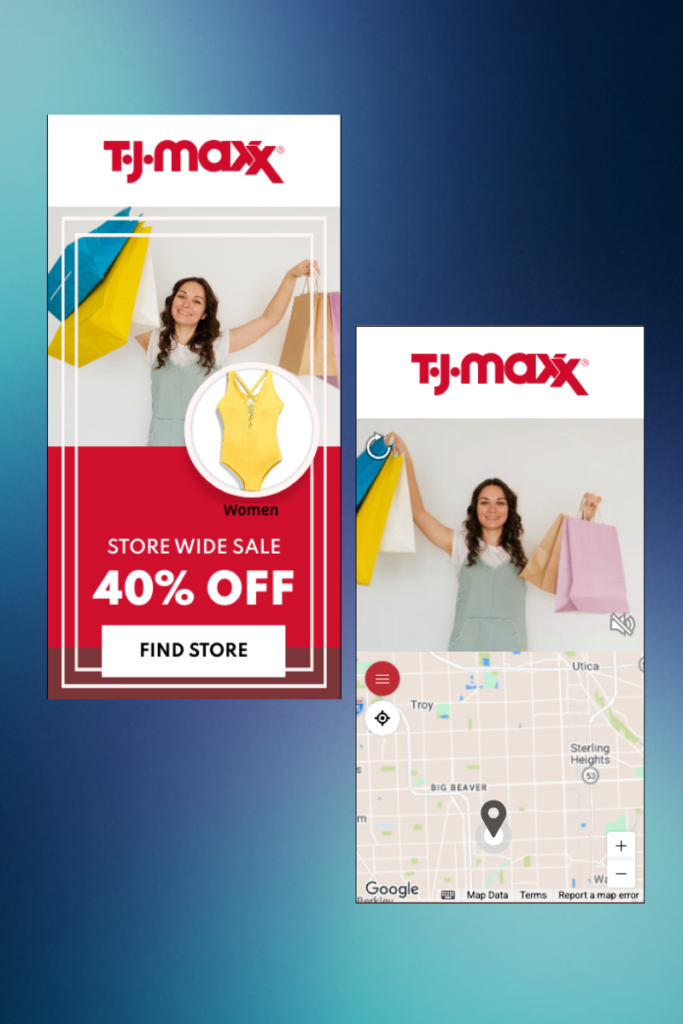
Advertising strategy: Remove friction and create urgency. Dynamic creative featuring real-time inventory, local availability, or time-sensitive offers; geo-fencing around store locations, malls, or competing retailers; click-to-purchase and click-to-pickup ads with direct connections to your e-commerce or store experience; mobile-first creative with singular, frictionless calls to action.
Goal: Drive the transaction — online, in-store, or through click-and-collect.
Stage 4: Loyalty — Retention and Advocacy
These are existing customers who’ve purchased before and represent your highest-value opportunity. Reactivating a lapsed buyer is significantly more cost-efficient than acquiring a new one, the brand familiarity already exists.
Typical signals include:
- Past purchase history, loyalty program activity, or app usage
- Lapsed engagement after an initial purchase
- High-LTV customer segments with cross-sell or upsell potential
- Social shares, reviews, or referral behavior post-purchase
Advertising strategy: Lead with recognition, reward, and relevance. Loyalty program activation ads featuring exclusive access, points reminders, or member-only offers; CRM-based retargeting using first-party purchase data to surface complementary products; referral campaigns built around existing buyers; lookalike modeling from high-LTV customers to find new shoppers with similar profiles.
Goal: Increase purchase frequency, grow basket size, and reduce season-over-season churn.
How to Build a Retail Audience Strategy
The total addressable market in retail can look limitless. Millions of in-market shoppers, multiple categories, national reach, but treating retail as mass marketing is where most programs fail. The shoppers most likely to convert this week are a much smaller, more predictable group than “people who buy things.”
At KORTX, we use an audience-first framework to help retail brands and agencies define the real addressable opportunity and build toward it.
- First-party data activation. Past purchasers, loyalty members, app users, and CRM contacts are the foundation. We use these audiences to retarget lapsed buyers, build lookalike models, and suppress active customers from prospecting spend, so no dollar is wasted reaching someone already in the funnel.
- Behavioral and intent segmentation. We segment beyond demographics, distinguishing the high-frequency online buyer from the in-store-only shopper, the deal-seeker from the premium spender, the new parent from the empty nester. Each segment gets a different message, a different channel mix, and a different call to action.
- Geographic precision. Retail audiences are layered geographically: shoppers within drive distance of a store location, click-and-collect zones, regional inventory availability, and national e-commerce reach. Campaign budgets and channels should reflect those tiers.
- Intent and contextual signals. Search behavior around product terms and brand comparisons, cart abandonment signals, review-site browsing, and category media consumption all indicate high-intent audiences worth prioritizing with conversion-focused creative.
- Dynamic exclusion. We actively manage audience suppression, excluding recent purchasers from acquisition campaigns, excluding loyalty members from first-purchase offers, and reserving specific budgets for lapsed and prospective segments most likely to deliver incremental revenue.
- KORTX Intelligence. Built on more than a decade of campaign performance data across 10,000+ campaigns, 1 billion+ user records, and 15,000+ audience attributes — including retail-specific behavioral, purchase intent, and category affinity data — helps us move from audience hypothesis to audience confidence before a campaign launches.
Retail Advertising Funnel Strategy
Retail campaigns must flex with the season, the promotion calendar, and the product lifecycle, but the funnel structure is consistent. The brands that perform year over year are the ones that show up at every stage: building awareness before a launch, converting during peak demand, and retaining customers after the transaction.
Top-of-Funnel: Build Awareness and Brand Preference
Tactics include CTV and online video showcasing new product lines, seasonal collections, or brand story; short-form social video on TikTok, Instagram Reels, and YouTube Shorts featuring product use, unboxing, or influencer integration; native and display placements in shopping, lifestyle, and category-relevant media environments; audio advertising reaching shoppers during commute and pre-purchase research windows.
The goal is to build brand preference and product familiarity before the high-intent shopping window opens.
Mid-Funnel: Drive Consideration and Purchase Intent
Tactics include retargeting for shoppers who visited product or category pages without purchasing; interactive ad units featuring product comparisons, size guides, reviews, or “find your fit” prompts; email and SMS capture through first-purchase offers, presales, or loyalty enrollment; dynamic creative that updates to reflect current pricing, availability, or promotional context.
The goal is to stay present during the consideration phase and make your product the obvious choice when the shopper is ready to buy.
Lower-Funnel: Convert Intent Into Revenue
Tactics include dynamic creative tied to real-time inventory, local availability, or time-sensitive promotional offers; geo-fencing around store locations, malls, and competitor retail zones; click-to-purchase and click-to-pickup ads connecting directly to your e-commerce or store pickup flow; mobile-first creative with clear, singular calls to action and minimal steps to checkout.
The goal is to make the path from intent to purchase as short as possible, online or in-store.
Post-Purchase: Build Loyalty and Lifetime Value
Tactics include thank-you and cross-sell flows surfacing complementary products based on purchase history; loyalty program activation featuring rewards reminders, member-only offers, and exclusive access; referral campaigns built from existing high-value buyers; CRM-based reactivation sequences for lapsed customers ahead of seasonal peaks.
The goal is to increase purchase frequency, grow average order value, and turn first-time buyers into long-term customers.
Retail Creative Strategy: Relevance, Convenience, and Urgency
In retail advertising, creative isn’t brand expression, but a purchase driver. The visual, the message, and the offer together determine whether a shopper clicks through or scrolls past. The most effective retail creative shares a few consistent traits.
- It leads with the product and the convenience. Shoppers aren’t looking for brand stories at the moment of purchase intent. They’re looking for the right product, at the right price, available where and how they want it. Lead with that.
- It uses real inventory data. “Only 3 left in your area” or “Order by 6pm for free pickup today” outperforms generic “Shop now” messaging because it creates urgency grounded in reality. Dynamic creative tied to live inventory is one of the highest-performing tools in retail advertising.
- It speaks to the shopper’s specific context. A shopper near a store location needs different creative than one browsing from home. A loyalty member needs different messaging than a first-time visitor. Segmentation isn’t just an audience tool, it’s a creative mandate.
- It removes friction at every step. Every additional click between the ad and the completed purchase costs conversions. The best retail creative minimizes steps, surfaces the offer immediately, and connects directly to checkout or store navigation.
- It adapts to the moment. Promotional events, flash sales, inventory drops, and seasonal peaks all warrant dedicated creative, not repurposed evergreen assets. Creative that reflects the specific moment outperforms always-on templates in almost every retail test.
Formats that consistently perform include dynamic display and video with live inventory and pricing feeds; short-form vertical video for social and pre-roll showcasing product use; interactive rich media with product selectors, size guides, and availability tools; geo-targeted mobile ads activated near store locations during high-traffic windows; DOOH and in-store digital signage synced to current online offers.
The Retail Marketing Calendar
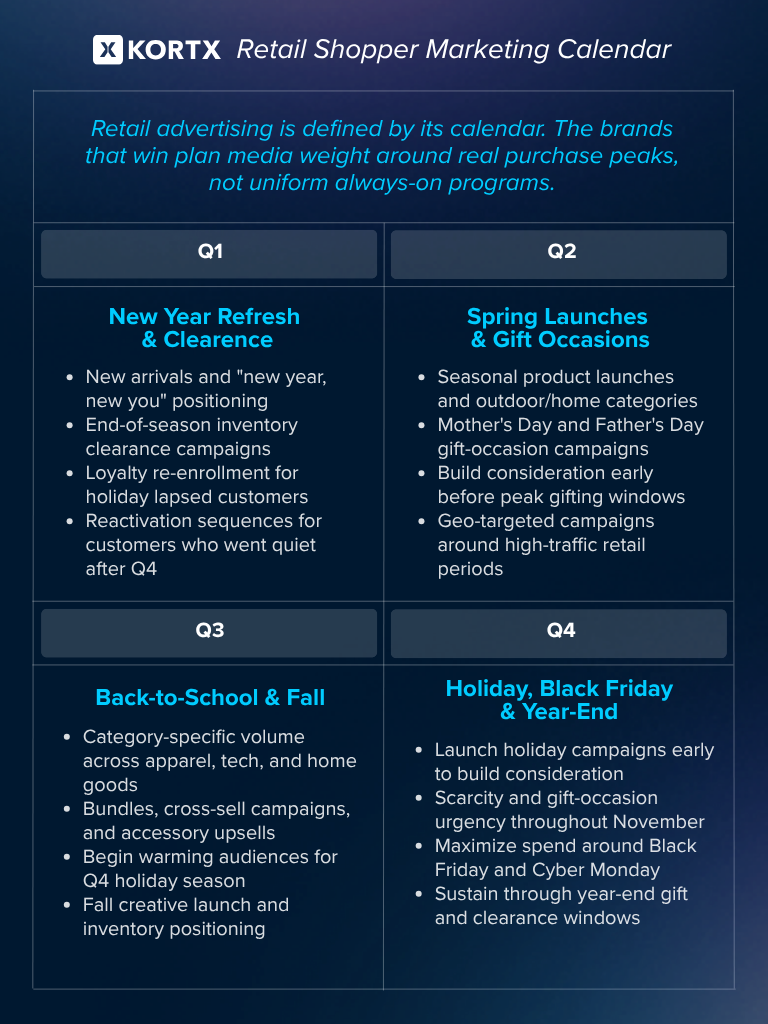
Retail advertising is defined by its calendar. Unlike most verticals, the demand curve is largely predictable, and the brands that plan media weight around it, rather than running always-on programs at uniform spend, consistently outperform.
- Q1 — New Year Refresh and Clearance. Shoppers are in reset mode. Focus on new arrivals, “New year, new you” positioning, and moving end-of-season inventory through clearance campaigns. This is also the window for loyalty re-enrollment and reactivating customers who lapsed during the holiday rush.
- Q2 — Spring Launches and Gift Occasions. Seasonal product launches, outdoor and home categories, and gift-occasion moments like Mother’s Day and Father’s Day drive mid-year volume. Launch new collections early, build consideration before peak gifting windows, and activate geo-targeted campaigns around high-traffic retail periods.
- Q3 — Back-to-School and Fall Inventory. One of the highest-volume retail periods outside of Q4. Back-to-school drives category-specific volume across apparel, tech, and home goods. Bundles, cross-sell campaigns, and accessory upsells perform well here. Begin building fall creative and warming audiences for Q4.
- Q4 — Holiday, Black Friday, and Year-End. The highest-urgency, highest-conversion period in retail. Media investment should peak here. Launch holiday campaigns early, build scarcity and gift-occasion urgency throughout November, maximize spend around Black Friday and Cyber Monday, and sustain through year-end gift and clearance windows.
Also layer in micro-moments throughout: product launches, flash sales, inventory drops, brand collaborations, loyalty program events, and competitive promotional responses. These windows of heightened shopper intent are among the most efficient conversion opportunities available if you have a program ready to activate quickly.
How to Measure Retail Advertising Performance
Retail brands aren’t buying impressions. They’re driving transactions, store visits, basket growth, and customer retention. Measurement frameworks need to reflect those outcomes, both online and offline. At KORTX, we connect media investment to the metrics that matter most to retail business performance.
The metrics we track include:
- Online revenue and ROAS by channel, campaign, and creative unit
- Cost per acquisition — first purchase and repeat purchase — calculated across channels
- In-store visit lift driven by digital campaigns, measured through foot traffic and store-locator data
- Average order value and basket size influenced by cross-sell and upsell creative
- Cart abandonment and recovery rates tied to retargeting programs
- Loyalty enrollment and repeat purchase rate among media-acquired customers
- Click-and-collect and BOPIS conversion rates driven by geo-targeted and availability-based creative
- Customer lifetime value: how media-acquired shoppers perform across seasons — repeat purchases, referral behavior, loyalty engagement
For agencies, we build reporting infrastructure that connects campaign performance to client business outcomes, making it straightforward to demonstrate media’s contribution to revenue, store traffic, and customer retention in client reviews.
KORTX’s Kampus dashboard provides real-time visibility into campaign performance across all channels, with the ability to optimize spend toward the placements and audiences driving actual transactions, not just clicks.
How KORTX Helps Retail Brands and Agencies
Retail advertising rewards brands that combine audience precision, omnichannel funnel activation, and dynamic creative built around real shopper behavior. KORTX partners with retail organizations and the agencies that serve them to deliver:
- Audience-first targeting built from first-party purchase data, behavioral signals, and KORTX Intelligence across 1B+ user records and 15,000+ audience attributes — including retail-specific category, intent, and loyalty indicators
- Full-funnel omnichannel activation across CTV, programmatic, paid social, audio, DOOH, and paid search — coordinated around the retail calendar and purchase cycle
- Dynamic creative strategies that adapt to real-time inventory, local availability, promotional windows, and shopper context
- Measurement frameworks that connect media spend to online revenue, in-store visits, loyalty growth, and customer lifetime value
- Agency partnership infrastructure including white-label reporting, client-ready dashboards, and dedicated strategic support
The result is advertising that moves shoppers through the funnel — from discovery to first purchase to loyal repeat buyer — with outcomes tied to the metrics retail organizations actually care about.
Final Takeaway: The Brands That Show Up at the Right Moment Win
Retail advertising is not about being everywhere. It’s about being in the right place — the right channel, the right creative, the right offer — when shopper intent is highest and the path to purchase is shortest.
The retailers and brands that drive consistent revenue are the ones who treat audience intelligence as a competitive advantage, align media investment to the rhythms of the purchase calendar, and build creative that speaks to convenience and urgency in equal measure.
At KORTX, we’ve helped retail brands and DTC organizations build exactly that kind of program: one that converts first-time browsers into buyers and one-time buyers into loyal customers.
Frequently Asked Questions
What is retail advertising?
Retail advertising is the strategy and execution of paid media designed to drive product discovery, online purchases, in-store visits, and customer loyalty for retail brands, DTC organizations, and omnichannel commerce. Effective retail advertising combines audience targeting, full-funnel campaign strategy, dynamic creative tied to real inventory and purchase behavior, and measurement that connects media investment to business outcomes like revenue, store traffic, and repeat purchase rates.
Unlike categories with longer consideration cycles, retail advertising operates across a wide range of purchase windows — from impulse decisions to weeks-long comparison journeys — which means campaigns must be built to reach shoppers at every stage and move them toward conversion efficiently.
How is retail advertising different from other verticals?
Retail advertising is defined by three characteristics that most other categories don’t share. First, the purchase journey is genuinely omnichannel — shoppers move between online discovery, in-store evaluation, and digital checkout in ways that don’t follow a linear path. Campaigns that live in a single channel miss most of the journey. Second, inventory and availability are performance levers. Real-time creative tied to local stock levels, delivery windows, and pickup availability drives meaningfully higher conversion rates than static promotional messaging. Third, the calendar is a strategic asset. Seasonal peaks, promotional events, and product launches create predictable windows of high purchase intent — and the brands that weight media toward those windows consistently outperform those running uniform always-on spend.
What is the best media mix for retail advertising?
A high-performing retail media mix typically combines connected TV and online video for product and brand awareness, paid social for discovery and mid-funnel engagement, programmatic display and dynamic creative for retargeting and inventory-aware conversion messaging, paid search to capture in-market shoppers actively comparing products or retailers, geo-targeted mobile for driving store traffic and click-and-collect conversions, and DOOH for local market presence in high-traffic retail environments. The right balance depends on the retail category, market footprint, and campaign objective. Awareness and launch campaigns lean toward CTV, social video, and native. Conversion campaigns prioritize dynamic display, retargeting, geo-targeted mobile, and search. Loyalty and retention campaigns rely on CRM-based audiences, app messaging, and personalized cross-sell creative.
How do you measure the impact of retail advertising on in-store sales?
Connecting digital media to in-store outcomes requires a combination of methods. Foot traffic lift studies measure the incremental increase in store visits among ad-exposed audiences compared to a matched control group. Store-locator click data and geo-fencing conversion tracking provide additional signals of digital-to-physical intent. CRM matchback analysis compares purchase records against ad exposure data to identify media-influenced in-store transactions. For brands with loyalty programs or first-party POS data, direct matchback provides the clearest view of media’s contribution to in-store revenue. At KORTX, we build measurement frameworks that surface these offline outcomes alongside digital conversions so clients have a complete picture of media performance.
How should retail brands structure advertising around seasonal peaks?
The most effective approach treats each phase of the retail calendar as its own campaign moment with distinct audience priorities, creative themes, and budget allocations. Q1 focuses on clearance, new arrivals, and loyalty re-enrollment. Q2 activates around spring launches and gift-occasion moments. Q3 drives back-to-school volume and begins warming audiences for the holiday season. Q4 demands peak investment — holiday launches, Black Friday and Cyber Monday activations, and sustained presence through year-end. Within that structure, layer in micro-moments: product launches, flash sales, inventory drops, and competitive response windows. These organic spikes in shopper intent are among the most efficient conversion opportunities available — provided you have creative and budget ready to activate quickly.
How does KORTX approach retail advertising for agencies?
KORTX works as a strategic and executional partner for agencies managing retail brand accounts. We bring audience intelligence built on more than a decade of retail and commerce campaign performance data, full-funnel omnichannel media execution, dynamic creative capabilities tied to live inventory and purchase signals, and analytics infrastructure that produces client-ready reporting connected to real business outcomes. For agencies, that means access to KORTX Intelligence — 1B+ user records, 15,000+ audience attributes, and 10,000+ campaign benchmarks — applied to your clients’ specific shopper segments, retail categories, and market footprints. We’re built to function as a seamless extension of your team, not a separate vendor relationship to manage.