



Google called it the “biggest upgrade to our Search box in over 25 years.” Here’s what that actually means for your campaigns, and your brand equity.
What Changed in Google Search (and Why It Matters Now)
Over the last 18 months, three compounding shifts have quietly changed how Google paid search works. None arrived with a press release. Together, they’ve changed who controls your brand in the auction, and it’s no longer just you.
1. Broad Match Now Matches on Intent
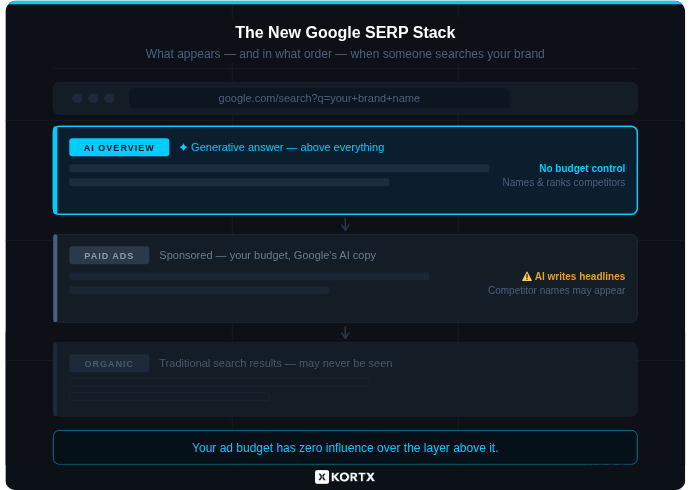
Broad match no longer means close variations of your keywords. Google’s AI now determines what queries are “close enough” based on inferred intent. A competitor bidding on a generic category term can legitimately have their ad served against searches that include your brand name. Google’s system decides what qualifies as relevant, not your team.
2. Google Is Writing Your Ad Headlines
Responsive Search Ads and Performance Max allow Google to assemble ad copy directly from your landing pages, feeds, and website. That includes competitor names pulled from comparison pages, blog posts, FAQs, or customer reviews. A headline featuring a competitor’s name can run in your paid ad without anyone on your team writing or approving it.
3. AI Overviews Are Competing With Your Ads
A generative answer now appears above the paid ad slot. It can name, rank, and recommend competitors before a user ever sees your ad. An AI-generated recommendation now sits above your ad, and one your budget has no direct influence over.
How Does Google’s AI Update Affect Campaign Performance?
This is where the impact becomes concrete for agencies managing accounts and brands protecting equity at scale.
Unapproved competitor names in your ads. Automatically Created Assets (ACA) is on by default. Google crawls your site and generates headlines you never wrote. Competitor names embedded in your own content — a comparison page, a FAQ, a testimonial — can surface in live ad copy.
Reduced visibility in Performance Max. PMax assembles and serves ads across six placements without showing which asset combinations ran on which queries. Brand exposure can go undetected for weeks.
Rising branded CPCs. Broad match expansion pushes competitor bids into your brand search auctions, inflating costs on terms you should own outright.
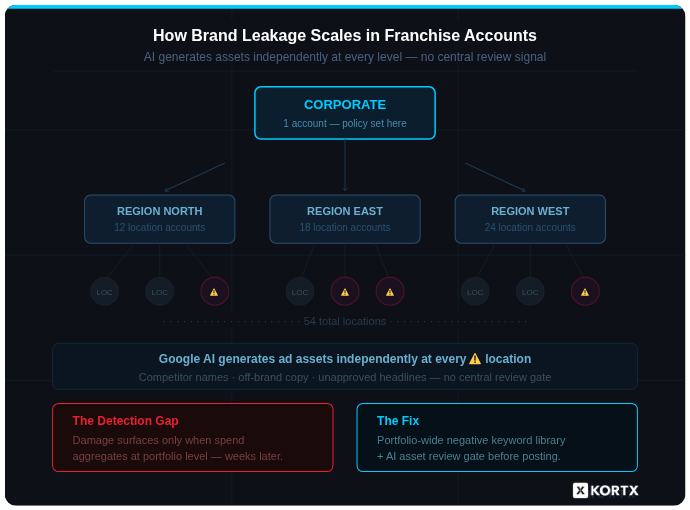
Compounded risk for franchise and multi-location brands. Distributed accounts — corporate, regional, local — each generate AI assets independently. Trademark equity can erode across hundreds of variants no one has reviewed.
In practice, this compounds faster than most corporate teams anticipate. A match type policy change pushed fleet-wide — say, enabling broad match across every location campaign on a corporate directive — expands query reach across hundreds of accounts simultaneously. Each location generates its own AI-matched queries independently. There is no centralized signal that anything is wrong until spend data aggregates at the portfolio level and the pattern surfaces. By then, weeks of budget have already run against queries the brand would never have approved. The damage is a governance architectural failure, and it scales exactly as fast as the platform does.
Is Google Search Dead? No, But the Rules Have Changed.
Industry headlines inflated Google’s announcement into a eulogy for traditional search. The reality is more nuanced: this is a meaningful evolution, not a replacement.
Google still heavily favors traditional search for queries with high commercial intent. AI experiences skew toward informational and research intent. Ads in AI experiences are also not available for all verticals, sensitive ad categories as defined by Google policy are generally excluded from AI Mode placements.
The brands that will lose ground are the ones optimizing keywords without updating how they govern their accounts. The brands that win are the ones treating this as an operating discipline problem, not just a campaign problem.
What Should Agencies and Brands Do About Google’s AI Changes?
Four Moves That Matter
- Govern the account structure. Standardize negative keyword lists, brand exclusion rules, and auto-applied recommendation settings across every account — corporate, regional, and local. This is an operational decision, not a creative one.
- Monitor the SERP, not just the dashboard. Auction Insights tells you who you’re competing with. It does not tell you what AI Overviews are recommending or what competitor copy says. SERP monitoring needs to become a weekly discipline, with documented evidence ready for trademark escalation.
- Pressure-test AI-generated assets. Turn off Automatically Created Assets where brand risk is highest. Audit Performance Max asset groups for competitor name leakage. Treat Google’s AI as a copywriter who needs supervision — because that’s exactly what it is.
- Build the defense playbook before you need it. A documented escalation path with Google. Pre-drafted trademark templates. An operator communication protocol for franchise systems. Brands that respond in 48 hours protect equity. Brands that wait two weeks lose it.
How Should You Allocate Budget Across Search, Performance Max, and AI Max?
The most effective approach treats Search, Performance Max, and AI Max as a single Google Ads budget — not standalone allocations. This lets spend flex toward whichever experience (traditional search vs. AI) is capturing intent as platform dynamics shift. Siloing budgets by campaign type creates artificial constraints that AI-driven platforms will route around anyway.
Five Things to Do This Week
If you want a fast read on where your brand stands today, start here. Or skip ahead and request a free paid search audit from KORTX — we’ll surface what’s already happening in your account.
- Pull the last 30 days of search terms. Are competitor brand names appearing in your match data? This is the fastest signal that the problem is already live in your account.
- Open Auction Insights for your top 10 brand terms. Who is overlapping with you, and at what impression share? This tells you who is actively bidding against your brand right now.
- Search your own brand name — signed out — in three local markets. What’s in the paid ad slot? What’s in AI Overviews? You may be surprised.
- List every Google Ads account associated with your brand. Corporate, regional, local, agency-managed. Confirm who has admin access to each. Distributed account structures are where brand leakage hides.
- Check auto-applied recommendation settings across all accounts. If “add broad match keywords” is enabled, turn it off until you’ve made a deliberate decision. This setting expands your match types without your approval.
The Bigger Picture for Franchise and Multi-Location Brands
For franchise and multi-location brands, Google Ads has surfaced something deeper: a brand governance gap. Distributed accounts — corporate, regional, local — each generating AI assets independently, with no unified standard for what runs or who reviews it.
The platforms will keep automating. The AI will keep generating. The brands that win are the ones that build an operating system around their media, with governance baked in at every level.
What that operating system actually looks like: a franchise network running hundreds of location campaigns across multiple brands builds a portfolio-wide negative keyword library and runs a structured mining pass on a weekly cadence — every account, every brand, every week. AI-generated RSA assets go through a review gate before posting, with a documented standard for what language is and is not approved to run. Performance Max asset groups are audited on a set interval for competitor name leakage and off-brand copy. Match type changes require a documented sign-off from the account team before a corporate directive reaches the platform. None of this is sophisticated. All of it is operational discipline that the platform will not enforce for you. The brands managing paid media at franchise scale that are holding ground right now are the ones that built this infrastructure before they needed it — not after a spend audit surfaced the gap.
How KORTX Can Help
KORTX is an independent performance marketing and analytics company serving national franchise brands, agencies, and embedded media partners. We help brands govern paid media at scale, protect brand equity across distributed account structures, and translate platform change into operating discipline.
We run a diagnostic for franchise and multi-location brands that covers the five-step review above, surfaces evidence of branded exposure, and delivers a prioritized action plan. Typical turnaround? Just two weeks.
Ready to see where your brand stands? Get your free paid search audit from KORTX — no pressure, just a clear picture of what’s happening and what to do about it.