



Political Advertising in 2026: An Audience-First Guide for Campaign Teams
TL;DR: Political advertising in 2026 will be shaped by audience-first strategy, behavioral data, and cycle-aware timing. Campaigns that align messaging to specific voter segments – across CTV, programmatic, social, and search – will outperform those using broad reach tactics.
Political advertising in 2026 is evolving in both scale and complexity, but the most meaningful shift is not in spend or channels, it’s in how campaigns approach the voter. In previous cycles, success was often driven by reach and repetition. Today, effectiveness depends on a campaign’s ability to understand who its voters are, what they care about, and how those priorities change over time. As we look ahead to the 2026 election cycle, campaigns that take a more informed, audience-led approach will be better positioned to drive engagement, improve efficiency, and influence outcomes.
Why Audience-First Political Advertising Works in 2026
Many campaigns still begin with messaging frameworks and policy priorities, then work to distribute those messages as broadly as possible. While that approach can generate visibility, it often lacks relevance at the voter level. An audience-first strategy reverses that process and begins with a clear understanding of the voter:
- What issues are most important to them
- How they consume media
- What motivates them to engage or take action
From there, messaging and media strategy are built to reflect those insights. This shift is particularly important in today’s environment, where voter attention is fragmented and expectations for relevance are higher. Campaigns that align messaging to specific audiences are more likely to break through and sustain engagement over time.
Which Political Issues Will Resonate in 2026?
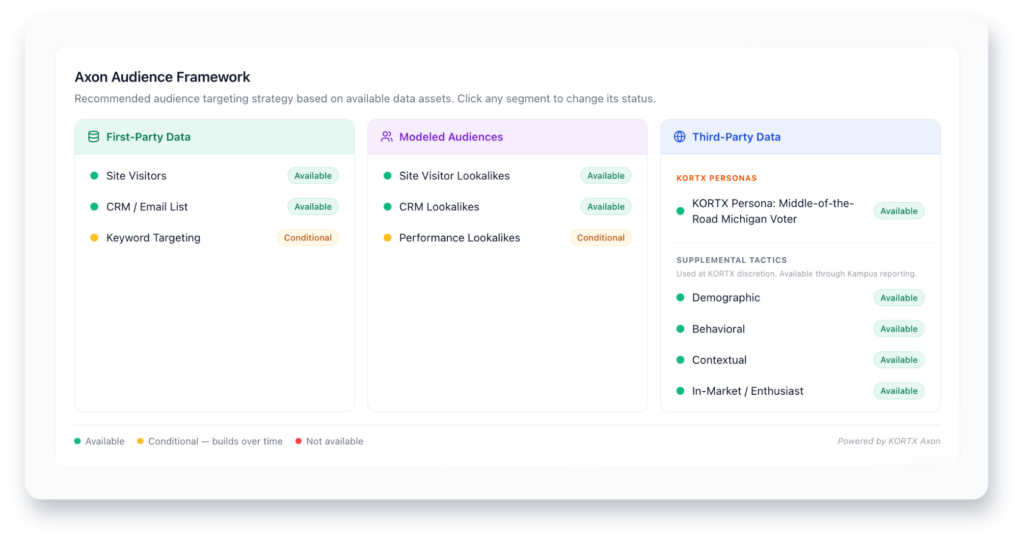
One of the most common challenges in political advertising is determining which topics will be most compelling in a given market. This cannot be solved through polling alone. While polling provides directional insight, it does not capture the full picture of voter behavior. A more complete view requires combining:
- Behavioral data
- Geographic and regional context
- Media consumption patterns
- Signals that indicate shifting priorities
For example, the issues that resonate with voters in the Midwest may differ meaningfully from those in the Southwest, even within the same election cycle. Priorities can also vary between suburban and urban audiences within the same state. Understanding these nuances allows campaigns to move beyond generalized messaging and develop communication strategies that reflect the realities of specific voter groups.
The KORTX Intelligence Approach
At KORTX, we approach political advertising through the lens of audience intelligence, ensuring that strategy is grounded in how voters actually think and behave.
Audience Persona Development
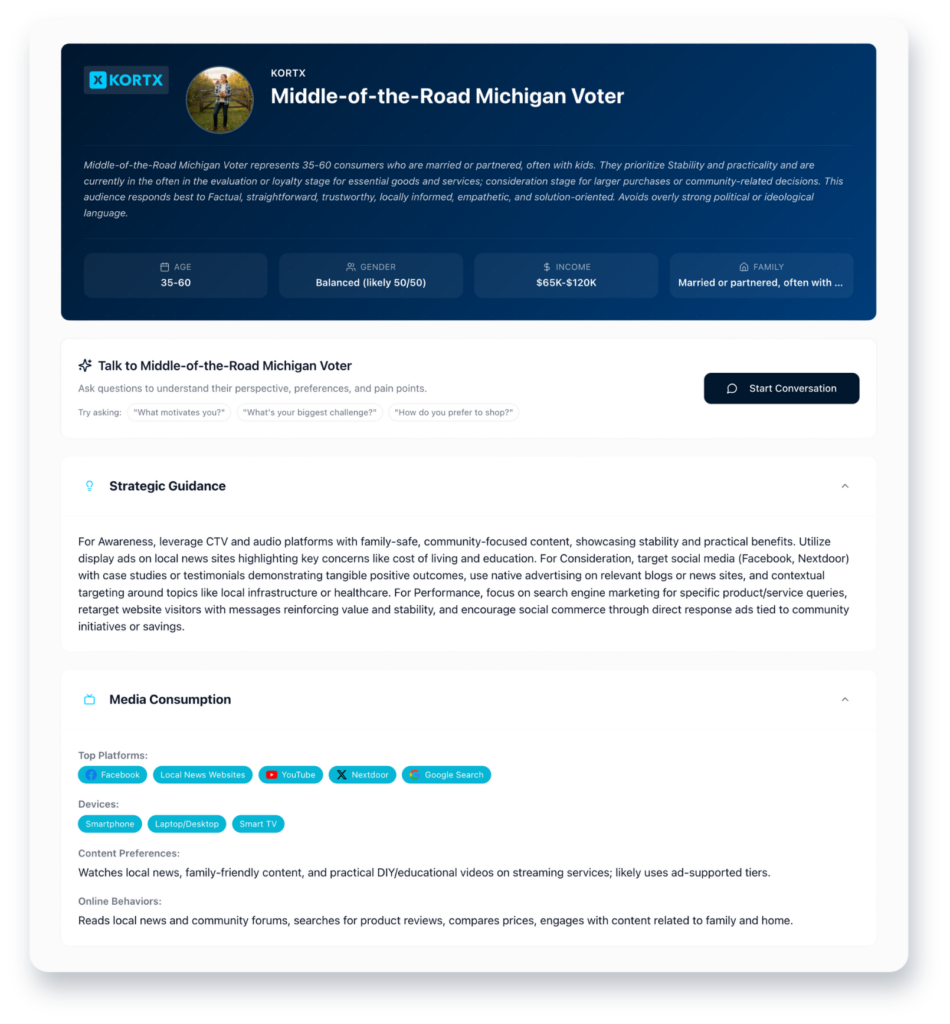
We begin by building detailed audience personas based on observed behavior, not just demographic profiles. These personas represent distinct voter segments, such as:
- Persuadable independent voters
- Issue-focused suburban households
- Lower-propensity voters approaching engagement
Each persona is informed by:
- Content and media consumption habits
- Issue alignment and interest areas
- Likelihood to engage or convert
This provides a practical foundation for both messaging and media planning.
Topic and Messaging Alignment
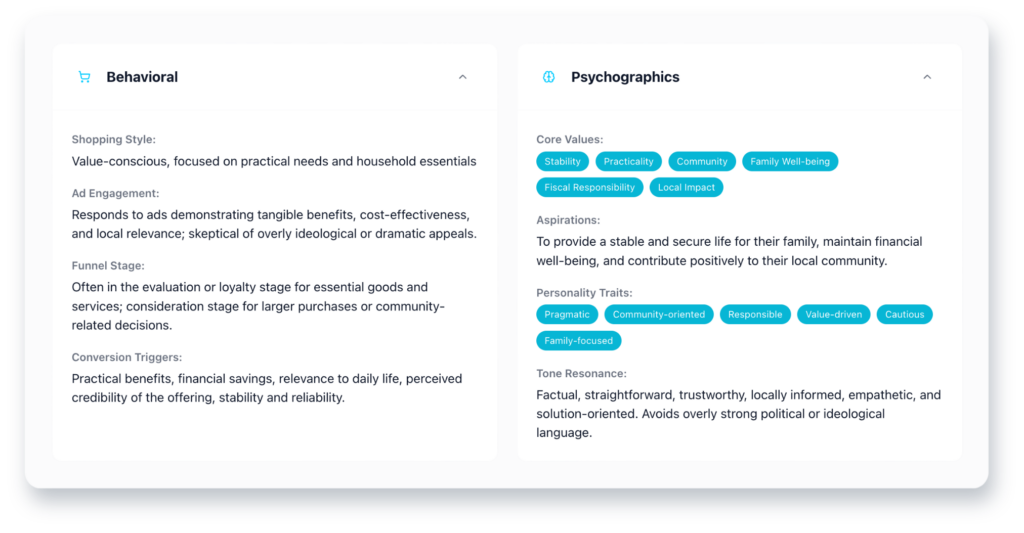
Once audiences are defined, we map key issues and messaging approaches to each segment, ensuring communication is tailored, not just generalized. For example, one audience segment may respond more strongly to messaging around economic stability, while another may be more focused on education or local policy. Aligning messaging to these priorities increases both relevance and effectiveness.
Media Strategy Informed by Behavior
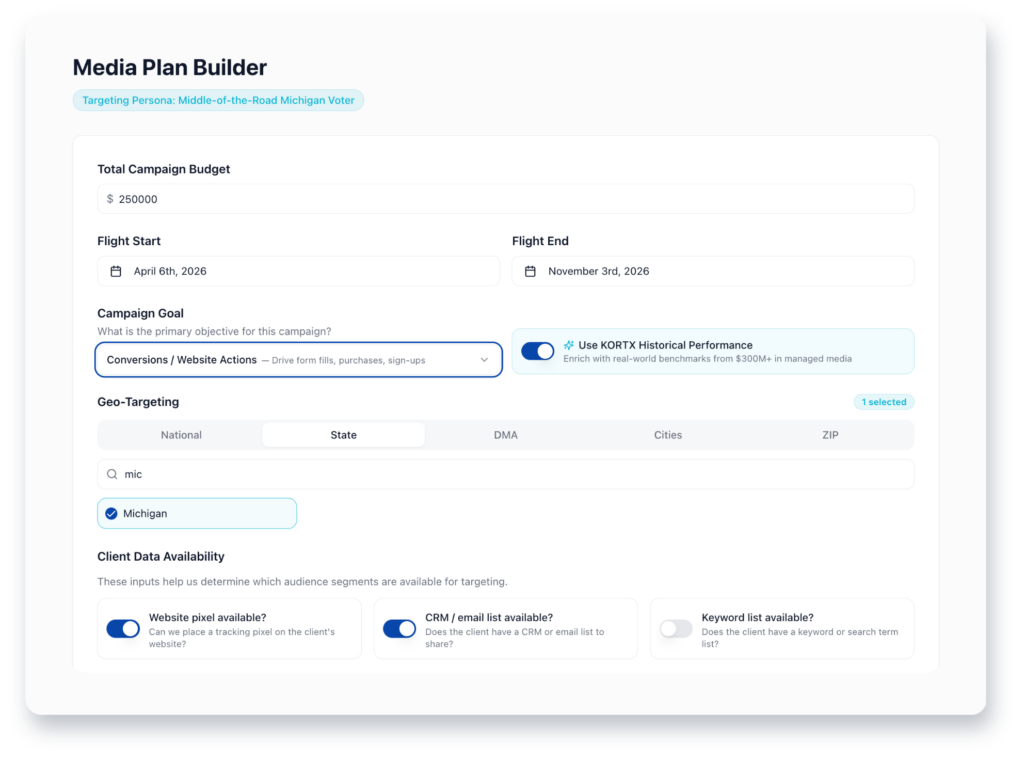
Media planning is then built around how each audience engages with content. Rather than prioritizing channels based on assumptions, we align investment with actual behavior:
- Connected TV supports high-impact storytelling in a streaming environment
- Social platforms enable consistent engagement and message reinforcement
- Search captures active interest and intent
- Programmatic channels allow for precise targeting and frequency management
This approach ensures that campaigns are not only reaching the right audiences, but doing so in environments where they are most receptive.
Aligning Strategy with Election Timing
In addition to audience and messaging, timing plays a critical role in campaign performance. Voter priorities and engagement levels shift throughout the election cycle, and campaigns must adapt accordingly.
Key Phases of the Cycle:
- Early phase: Building awareness and establishing issue alignment
- Mid-cycle: Driving persuasion and differentiating candidates or positions
- Late phase: Increasing urgency and supporting turnout efforts
As voters move through these phases, the type of messaging that resonates with them changes. Campaigns that recognize and plan for these shifts are better able to maintain relevance and momentum.
Where and When Strategy Matters Most in 2026
The 2026 cycle includes a wide range of elections, each with different timelines, voter dynamics, and levels of competition. These include:
- U.S. House and Senate midterm races
- Governor races across key states
- State and local elections with highly targeted voter bases
While these elections fall within the same cycle, they do not operate on the same timeline or voter mindset. For example:
- A governor’s race in a large, diverse state requires a different audience strategy than a localized ballot initiative
- Competitive Senate races often demand earlier investment in persuasion, while local elections may require more concentrated efforts closer to voting periods
Understanding where each race sits — geographically and within the election timeline — allows campaigns to:
- Prioritize investment effectively
- Adjust messaging by region and audience
- Align media strategy to when voters are most receptive
At KORTX, we map these dynamics early to ensure campaigns are not only reaching the right audiences, but doing so at the right time within each market.
Lessons from Previous Campaigns
Across the campaigns we have supported, a consistent pattern emerges: relevance is a stronger driver of performance than scale alone. Campaigns that perform well tend to:
- Define audiences clearly before activating media
- Align messaging with specific voter priorities
- Maintain consistency across channels while adjusting creative by segment
By contrast, campaigns that rely on broad messaging or uniform creative often see diminished engagement and less efficient use of budget.
The Best Political Advertising Media Mix for 2026
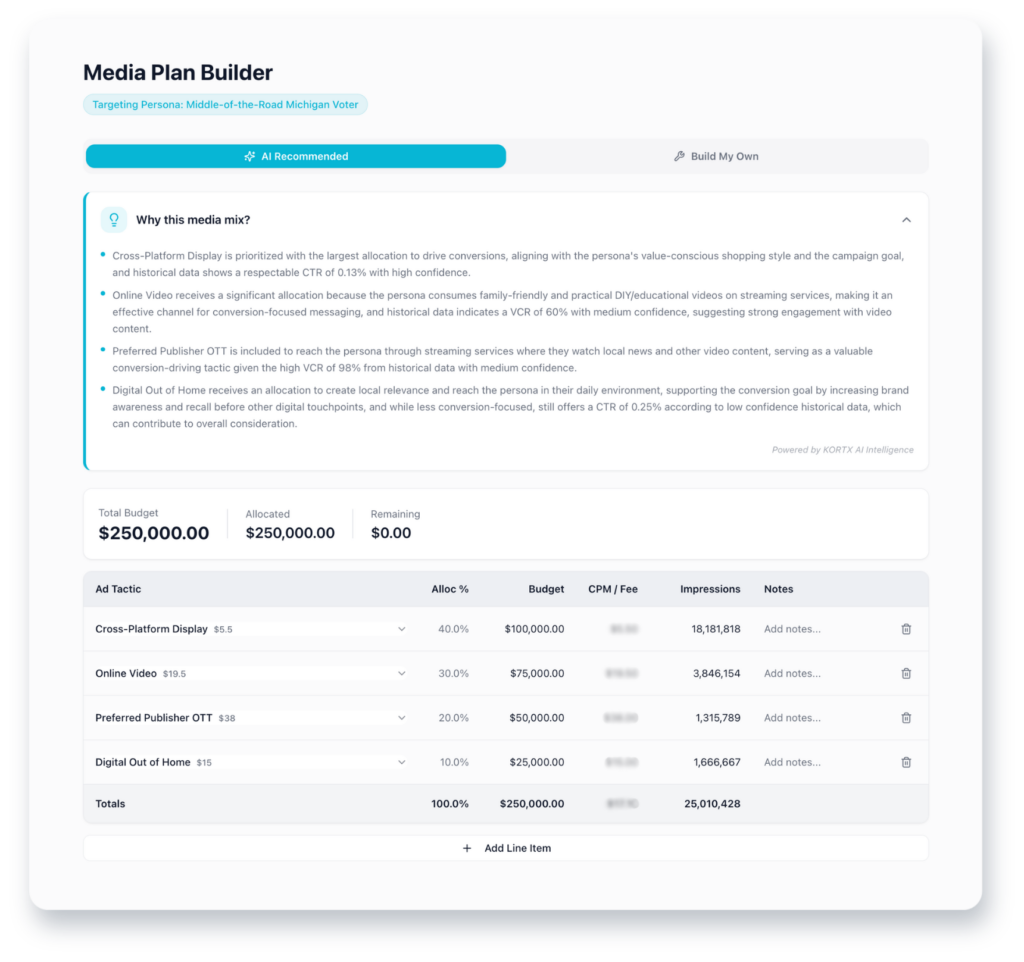
While traditional channels continue to play a role, the overall media mix has shifted toward more flexible and data-informed approaches. A balanced strategy typically includes:
- Connected TV (CTV): For reach and storytelling within streaming environments
- Programmatic Display: For targeted delivery and reinforcement
- Social Media: For engagement and ongoing message exposure
- Search: For capturing voters actively seeking information
Coordinating these channels effectively allows campaigns to support the full voter journey, from initial awareness through action.
Bringing It All Together
At its core, an effective political advertising strategy connects four key elements: Audience → Insight → Messaging → Media. When these elements are aligned, campaigns are better equipped to:
- Reach the right voters
- Deliver relevant messages
- Adapt to changing conditions
- Improve overall performance
This is the foundation of how KORTX approaches political advertising. As the 2026 election cycle approaches, the media landscape will continue to evolve and voter expectations will continue to shift. Campaigns that rely on broad assumptions or static strategies will find it increasingly difficult to maintain effectiveness. Those that invest in understanding their audiences, align messaging to real priorities, and execute with precision will be better positioned to succeed.
Frequently Asked Questions
What is audience-first political advertising?
Audience-first political advertising is a strategy that begins with a deep understanding of voters — their priorities, behaviors, and media habits — before developing messaging or media plans. Rather than broadcasting one message broadly, it tailors communication to specific voter segments, increasing relevance, engagement, and overall campaign efficiency.
Traditional political advertising often starts with a candidate’s policy platform and distributes it as widely as possible. Audience-first flips that model. It uses behavioral data, geographic context, and media consumption signals to identify distinct voter segments, then builds messaging and channel strategy around how each segment actually engages. This approach is especially important in 2026, when voter attention is fragmented across platforms and expectations for relevance are higher than ever.
How is 2026 political advertising different from previous cycles?
The 2026 cycle is defined by fragmented voter attention, the continued rise of connected TV (CTV), and a shift from reach-based strategies to data-informed, audience-led planning. Campaigns can no longer rely on repetition alone — effectiveness now depends on delivering relevant messages to specific voter segments across multiple screens and platforms.
Three shifts stand out. First, voter attention is more fragmented than in any previous cycle, making broad reach strategies less efficient. Second, CTV has moved from a supplementary channel to a central pillar of political media, replacing much of what linear TV used to deliver. Third, behavioral data and audience intelligence are now accessible enough that campaigns can build strategies around how voters actually behave, not just how they poll. Campaigns that embrace these shifts will outperform those that stick to legacy playbooks.
What’s the right media mix for a 2026 campaign?
The ideal 2026 political advertising media mix combines Connected TV for reach and storytelling, programmatic display for precision and reinforcement, social media for ongoing engagement, and search for capturing active voter intent. The right balance depends on the race, the audience, and the phase of the election cycle.
Each channel plays a distinct role. Connected TV (CTV) delivers high-impact storytelling in streaming environments where voters increasingly spend their time. Programmatic display enables precise audience targeting and frequency management across the web. Social media drives engagement and message reinforcement. Search captures voters actively seeking information about candidates, issues, or ballot measures. No single channel wins alone — coordinated delivery across these channels supports the full voter journey, from initial awareness to final action.
When should political campaigns start advertising for 2026?
Most competitive 2026 campaigns should begin advertising 9–12 months before election day, with timing varying by race type. Competitive Senate and governor races typically benefit from early investment in awareness and persuasion, while local elections and ballot initiatives may concentrate spend closer to key voting periods.
Campaign timing generally follows three phases. The early phase (9–12+ months out) focuses on building awareness and establishing issue alignment with target audiences. The mid-cycle (3–9 months out) is where persuasion and candidate differentiation happen. The late phase (final 8 weeks) increases urgency and supports get-out-the-vote efforts. Because voter priorities and engagement shift across the cycle, campaigns that plan for these phases — and adjust messaging and media weight accordingly — consistently outperform those running a single, static strategy.
How does KORTX approach political advertising?
KORTX approaches political advertising through audience intelligence, building strategies grounded in how voters actually think and behave. We develop behavioral personas, align messaging to specific voter priorities, and plan media around real engagement patterns across CTV, programmatic, social, and search — helping campaigns drive engagement, efficiency, and measurable outcomes.
Our process follows four connected steps: Audience → Insight → Messaging → Media. We start by building detailed voter personas based on observed behavior, not just demographics — including persuadable independents, issue-focused suburban households, and lower-propensity voters. We then map key issues and messaging approaches to each segment, ensuring relevance rather than generalization. Finally, we design media plans around how each audience actually consumes content, coordinating CTV, programmatic, social, and search to support voters across the full journey.
Let’s Build a More Informed Campaign
KORTX works with political campaigns to translate audience insight into effective media strategy, helping teams navigate complexity and make more informed decisions throughout the election cycle. Curious how this could apply to your campaign? Request a 2026 campaign strategy consultation → Let’s chat.